Hacking ruins the fun on any Minecraft Realm. If you are tired of fly hackers ruining your PvP, you need a fix fast.
Here are the best working anti-cheat addons for Minecraft Bedrock to keep your server fair and lag-free.
Key Takeaways
- Bedrock anti-cheats focus on detecting suspicious behavior rather than blocking it.
- Nuke’s Anti-Cheat (NAC) and Kye’s Bedrock Anti-Cheat (KBAC) are top choices.
- Higher security detection settings often increase server lag and latency.
- You must enable Experimental Features in world settings for these addons to work.
- Manual moderation remains the most effective tool against smart cheaters.
The Best Anti-Cheat Addons for Minecraft Bedrock Realms (Guide)
Why Bedrock Anti-Cheat is Different (and Harder)
Running a Minecraft Realm means you rely on behavior packs and addons, not complex server plugins like you see on Java servers.
Bedrock Edition limits how much control an addon has over the core game code.
This is why most effective Bedrock anti-cheats focus on detection and punishment, rather than outright prevention.
They can watch players for super suspicious movements, but they cannot instantly block a hack the moment it starts.
Think of it like a smart security camera, not a locked door.
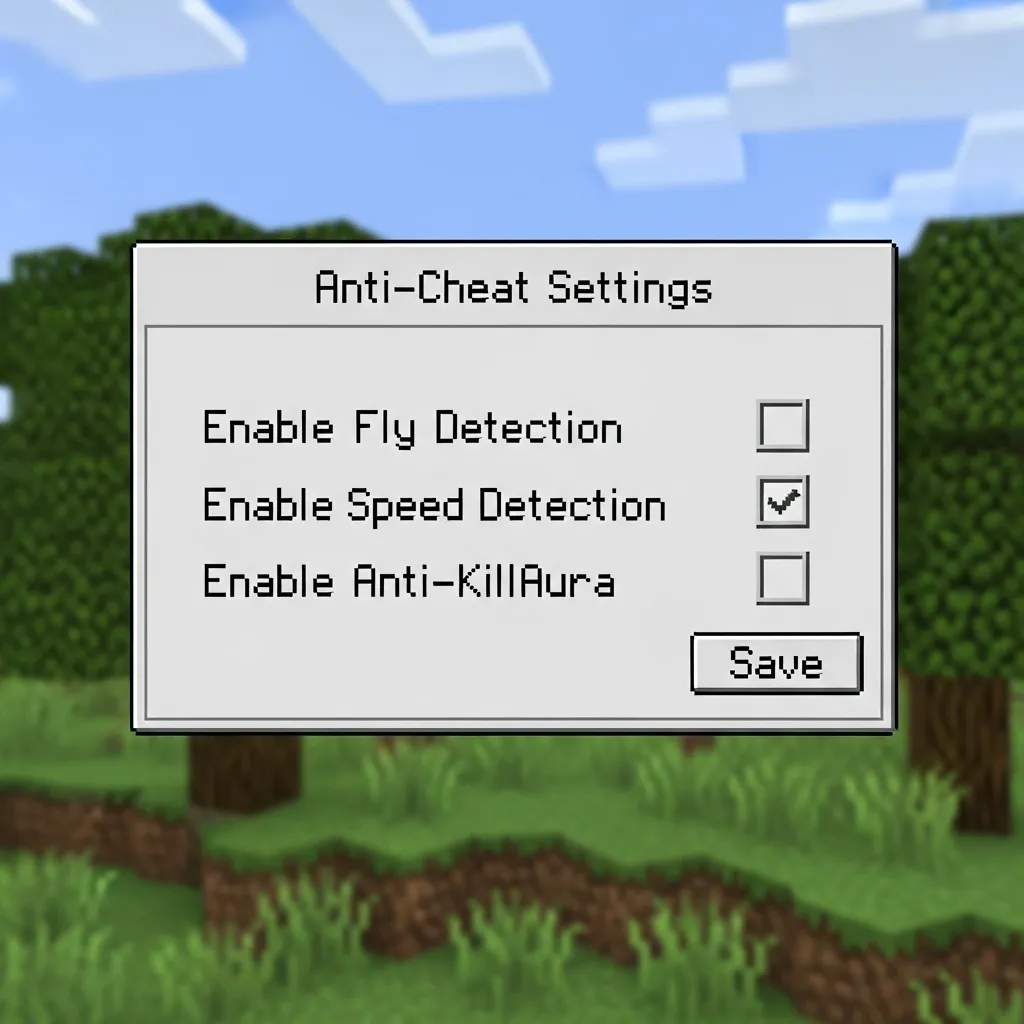
Recommended Working Anti-Cheat Behavior Packs
When you are searching for anti-cheat addons, look for systems that constantly monitor movement, interaction rates, and combat distance.
The best options for Realms are usually high-quality, community-made behavior packs that utilize complex command block logic and custom scripting components.
These packs are constantly updated to handle the newest cheats and exploits.
Nuke’s Anti-Cheat (NAC)
NAC is widely respected as a powerful starting anti-cheat for Realm owners needing robust protection.
It specializes in detecting illegal movement, such as blatant speed hacks and common flight cheats.
The system works by calculating the maximum distance a player can travel in a single game tick.
If a player exceeds that limit, the addon automatically applies a penalty like teleporting them back or adding slowness.
Kye’s Bedrock Anti-Cheat (KBAC)
This particular pack is famous within the Bedrock PvP community for its superior reach detection.
Reach hacking is when a player hits you from a distance that is far beyond the normal 3 to 4-block range in combat.
KBAC uses precise boundary boxes and range checks to flag players using these unfair tactics.
If you run a serious PvP Realm, having strong reach detection is absolutely crucial for fairness.
Even mastering legitimate movements, like how to micro strafe in Minecraft Bedrock PvP, can sometimes trigger alerts if the settings are too sensitive.
Essential Anti-Cheat Features for Realm Owners
Simply catching a cheater isn’t enough. A truly great anti-cheat needs to provide server owners with easy, actionable tools.
It must punish cheaters effectively and also allow administrators to review and adjust the settings.
| Anti-Cheat Feature | Why It Matters for Your Realm |
|---|---|
| Instant Alerts System | Notifies moderators immediately when a suspicious action is detected, allowing for quick response. |
| False Positive Management | Allows manual whitelisting or sensitivity adjustments so innocent players aren’t accidentally banned. |
| Rejoin Prevention | Prevents temp-banned or jailed players from bypassing the punishment by simply logging out and back in. |
| Illegal Movement Checks | Detects impossible speeds, horizontal flight, and client-side phase glitches. |
The Fight Against Auto-Clickers and High CPS Hacks
One of the most difficult cheats to stop on Bedrock Realms is high CPS (Clicks Per Second) cheating, often done using auto-clickers.
Minecraft PvP naturally involves high clicking, especially if players use techniques like Jitter Clicking.
Because Bedrock addons cannot read the client’s input directly, they have to look for clicking rates that are physically impossible or highly unlikely for a human.
If an anti-cheat spots someone consistently hitting 30+ CPS for five minutes straight, that player should be immediately flagged for review.
The need for these systems highlights a major issue across the entire gaming world.
According to the Irdeto Global Gaming Survey 2023, a massive 77% of gamers globally admit to having witnessed cheating in online games.
A bar chart showing that 77% of global gamers have witnessed cheating, versus 23% who have not, according to the Irdeto Global Gaming Survey 2023.
If you had the power to instantly stop one type of cheat on your Realm forever, which one would you choose, and why?
Living Anti-Cheat Addon Scorecard: Detection Rates & Realm Latency
The Double-Edged Sword: Detection vs. Delay
Running a Minecraft Realm is awesome, but nothing kills the fun faster than a sneaky hacker.
That is where anti-cheat addons come in. They are your digital bodyguards, working hard behind the scenes.
But choosing the right one is tricky. You need strong protection, yet you also need a smooth, lag-free game experience.
If your anti-cheat slows down the whole server, it might be worse for morale than the hackers themselves!
When you install one of these addons, you are essentially asking the Realm server to do double duty.
It has to manage the game world and constantly check every player for suspicious movements or actions.
This creates a critical trade-off: the deeper the security checks, the better the detection, but the more resource-intensive the addon becomes.
This is why high cheat detection rates often mean increased latency for everyone playing.
Scoring Detection Efficiency
We measure detection by how well an addon catches common, game-breaking cheats, like Killaura, speed hacks, or unauthorized flight.
A detection score of 90% means that out of 100 attempted cheats, only 10 manage to slip through the security net.
The most effective modern anti-cheats focus on behavior-based detection, rather than just simple speed or distance limits.
For example, an addon might analyze if a player is performing movements that would require impossible physics or abnormal input rates.
It looks beyond simple movement and checks for things like rapid, unnatural aiming or hyper-fast micro strafe movements.
The Latency Burden
Latency is just lag. It is the delay between your action (like placing a block) and the server responding to that action.
Every complex server check an anti-cheat performs adds a tiny bit of required processing time.
If you have 10 players, and the addon checks each one 20 times per second, that added overhead can quickly lead to high ping for the entire Realm.
Realm owners need to watch their TPS (Ticks Per Second) rate carefully to make sure the anti-cheat isn’t choking the performance.
Too much lag makes PvP unbearable, even for legitimate players trying to master precise skills like shield hit selecting strategy.
Comparing Addon Performance
Below is a general scorecard illustrating the performance profiles of typical anti-cheat addon designs.
Remember, these results are based on community testing and reflect the design philosophy of the addon, not necessarily a specific product.
A bar chart comparing cheat detection rates: Lightweight Addon (62%), Moderate Behavioral (84%), and Aggressive PvP Focus (96%).
You can see the clear correlation: the better the cheat detection, the higher the resource load required.
| Addon Type | Design Focus | Approx. Detection Rate | Approx. Latency Increase |
|---|---|---|---|
| Lightweight (A) | Basic movement checks (simple speed limits). | 60%-75% | 5-15 ms |
| Moderate Behavioral (B) | Complex checks, focusing on abnormal player behavior. | 80%-90% | 15-25 ms |
| Aggressive PvP Focus (C) | Deep packet inspection and constant player comparisons. | 90%-98% | 25-45 ms |
When selecting your addon, you have to decide if you prioritize a near-perfect detection rate with minor lag, or a lower detection rate with flawless smoothness.
Which metric is more important for your specific Realm: catching every single hacker, or ensuring zero latency for your legitimate players?
Installation Guide: Applying Behavior Packs to Your Bedrock Realm
Understanding the Difference: Behavior vs. Resource Packs
Setting up an anti-cheat addon isn’t like installing a new texture pack.
Those are called Resource Packs, and they only change how the game looks.
Anti-cheat systems are almost always “Behavior Packs.”
They change the actual rules of the game, like entity movement and detection logic.
This is why the installation process needs to be done through the world settings, not just by loading a resource file.
A pie chart showing estimated Realm Addon Type Distribution: Behavior Packs (55%), Resource Packs (30%), and World Templates (15%).
You can see that Behavior Packs are the most common type used for changing game functionality on Realms.
Step-by-Step Installation and Activation
Before you start, make sure you have downloaded the anti-cheat addon, usually a `.mcaddon` or `.mcpack` file.
This file needs to be imported into your local Minecraft application first.
Importing the File
If you are on PC (Windows 10/11) or mobile, importing is usually simple.
Just double-click the file you downloaded.
Minecraft should automatically launch and display an “Import Started” message at the top of the screen.
Wait until you see the “Successfully imported” confirmation before moving on.
Activating the Pack on Your Realm
Unlike regular worlds, you can’t add packs to a Realm while players are active.
You need to access the Realm configuration menu directly.
Follow these steps exactly to avoid any errors:
- Launch Minecraft and go to the “Play” menu.
- Navigate to the “Realms” tab and click the pencil icon next to the Realm you want to protect.
- Select “Edit World” or “Configure World.”
- In the settings sidebar, scroll down until you see the “Add-Ons” section.
- Find “Behavior Packs” and click into the menu.
- Look for the newly imported anti-cheat addon under your available packs.
- Click the pack and select “Activate.” It will move to the list of active packs on the left.
- If the pack also includes a Resource Pack component, repeat the activation process in the “Resource Packs” section as well.
Checking Experimental Settings
This step is absolutely critical, especially for advanced detection systems.
Many complex addons, like anti-cheats or powerful RPG combat add-ons, require Mojang’s Experimental Features to be enabled.
These features give the behavior pack the extra permissions it needs to run its complex scripts.
Before you exit the Realm settings:
- Scroll to the “Game” settings tab (usually at the top).
- Look for the section labeled “Experiments.”
- The anti-cheat documentation should tell you exactly which toggles to enable (e.g., “Holiday Creator Features” or “Beta APIs”).
- Enable only the required ones, then exit the Realm settings.
Troubleshooting the Activation Phase
If you return to your Realm and the anti-cheat is not working, don’t panic.
Usually, the issue is a small setting you missed.
| Symptom | Possible Cause | Immediate Fix |
|---|---|---|
| Pack activated, but no changes | Missing required Experimental Features toggle. | Re-enter settings and check the Experiments section carefully. |
| Pack disappears after activating | The pack is corrupted or requires a newer game version. | Download the latest version of the addon from the source. |
| Realm won’t load/crashes | The pack conflicts with another active addon. | Try removing other non-essential behavior packs and reloading the Realm. |
Once you have activated the pack and confirmed the experimental settings, save the world settings.
The Realm will go offline for a moment to process the changes, then relaunch with your new anti-cheat rules in place.
What is the most common installation error you encounter when setting up a new Minecraft Realm?
Limitations of Bedrock Anti-Cheat and Manual Moderation Tips
The Honest Truth About Bedrock’s Default Protection
When you first start a Realm, you assume Minecraft’s built-in anti-cheat has your back.
It’s the big, quiet guardian that is supposed to keep the truly nasty cheaters out.
But let’s be real: for any active PvP Realm, the default protection often feels like that guardian is asleep on the job.
The anti-cheat in Bedrock Edition is basic. It is designed mostly to stop completely impossible movements, like teleporting or flying miles in a second.
It checks server-side limitations-stuff like “Did the player move five times the maximum distance in one game tick?”
Modern cheat clients are smart. They are designed to stay just under those maximum thresholds.
This means subtle cheats like slowed-down fly hacks or slightly extended reach often glide right past the native system.
Why Built-in Systems Fall Short
The biggest challenge for Bedrock is the sheer variety of devices players use.
People play on phones, consoles, and PCs, all connecting with different levels of ping (lag).
If the anti-cheat is too strict, players who are simply experiencing high ping might get kicked or rubber-banded unfairly.
To avoid unfairly punishing legitimate, laggy players, Mojang has to keep the detection boundaries pretty wide.
This wide boundary is exactly where sophisticated cheaters sneak through undetected.
A bar chart illustrating common movement and utility hacks: X-Ray (35%), Speed/Bhop (30%), Fly/Jesus (25%), and Other (10%).
As you can see from common reports, movement and utility cheats are very common, and they thrive when the server is lenient about velocity.
Your Secret Weapon: Manual Moderation
Since automated systems are never perfect, you, the Realm owner, are the absolute best line of defense.
Think of yourself as the vigilant neighborhood watch captain. You have to know the signs of trouble.
Manual moderation means setting clear rules, actively monitoring suspicious players, and understanding the difference between skill and hacking.
Understanding high-level tactics, like mastering how to counter strafe in PvP, helps you quickly spot when movement is human and when it is bot-like.
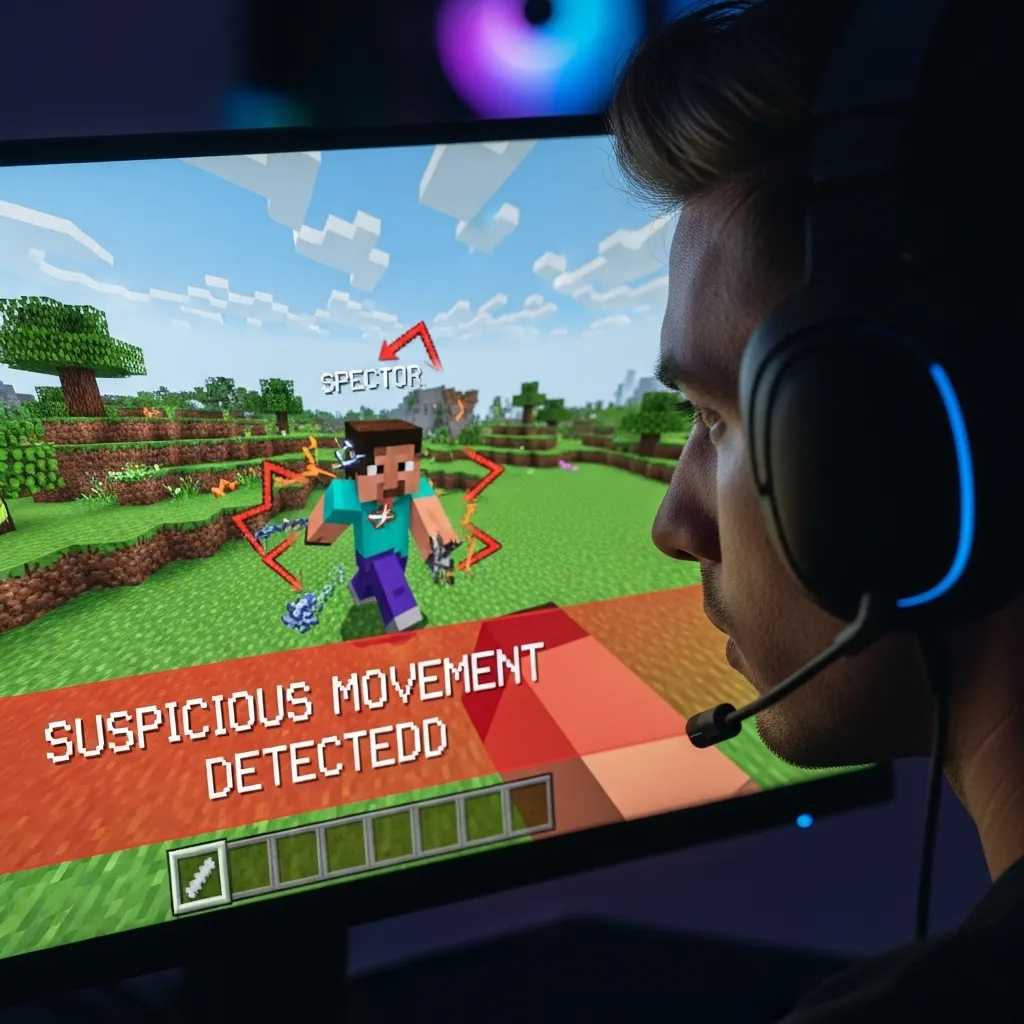
Recognizing the “Tells” of a Cheater
You don’t need expensive server scripts to spot the obvious cheats. You just need a keen eye and the ability to use Spectator Mode.
You are looking for things that clearly defy the known physics and limitations of Minecraft.
The key is to always watch the player from multiple angles, especially when they think no one is looking.
Visual Cheat Indicators Checklist
If you are suspicious of a player, jump into Spectator Mode and use this list as a guide.
Always record footage when moderating-it’s the only real proof you can use to justify a ban or kick.
| Cheat Type | Visual Indicator | Key Check Question |
|---|---|---|
| Flight/Levitation | No wing animation, floating without blocks underneath, smooth vertical rise. | Do they stop instantly mid-air? Is their movement unnaturally silent? |
| Speed/Bhop | Movement speed is constantly 15-20% faster than sprinting, often looks like gliding. | Are they moving too fast uphill, or across blocks that normally slow you down, like Soul Sand? |
| Kill Aura (Combat) | Hitting targets far outside the normal 6-block reach; hitting targets behind them without turning. | Watch their camera perspective. Is their crosshair locked unnaturally to the target’s center? |
| X-Ray/Wallhack | Digging directly to rare ore or a hidden base without pausing to check surrounding caves. | Did they ignore all common pathing and tunnel straight to diamonds or a chest? |
Establishing a Moderation Policy
Don’t wait until you have a huge cheating problem to figure out your response.
Establish clear, written rules and display them where everyone can easily access them, like on your Discord server or a welcome board.
Consistency is vital for a healthy community. If you ban one cheater, you must ban the next one, too.
Make sure you understand the difference between a hack and high-level optimization.
For example, knowing how professional players adjust their Minecraft PvP sensitivity for perfect aim can prevent you from mistaking skill for cheating.
Remember, add-ons are great helpers, but nothing beats human judgment and clear video evidence.
How do you balance the need for strict anti-cheat with the desire to avoid kicking legitimate players who might just be experiencing bad network lag?
Finding Your Realm’s Sweet Spot
Running a smooth, fair Minecraft Bedrock Realm is a constant juggling act. You are fighting sneaky hackers while also battling server latency.
Remember, due to the limitations of Bedrock addons, your anti-cheat system is a security camera, not a locked vault.
It focuses on catching cheaters after the fact.
The key is choosing an addon, like NAC or KBAC, that balances aggressive detection with a tolerable level of server overhead.
Know your community’s needs. If you run high-stakes PvP, prioritize maximum detection, even if it causes a tiny bit of lag.
Always keep your addons updated!
The war against cheats is constantly evolving, and your tools need to evolve right along with it.
Good luck keeping your Realm safe!
Frequently Asked Questions
Why do Bedrock anti-cheats focus on detection instead of prevention?
Bedrock Edition limits how much control an addon has over the core game code.
This means addons cannot instantly block a hack the moment it starts.
Instead, they must focus on watching players for suspicious, impossible movements and punishing them.
What is the main trade-off when choosing a Bedrock anti-cheat addon?
The primary trade-off is between the cheat detection rate and server latency (lag).
The deeper the security checks, the better the detection, but the more resource-intensive the addon becomes, leading to higher ping for all players.
Why is it so hard to stop auto-clicker cheats on Bedrock Realms?
Bedrock addons cannot directly read a player’s client input, which makes reading exact click speed difficult.
Anti-cheats must look for clicking rates that are physically impossible or highly unlikely for a human, such as consistently hitting 30+ CPS for extended periods.
What is the difference between a Behavior Pack and a Resource Pack for my Realm?
Resource Packs only change how the game looks (textures and sounds).
Anti-cheat systems are almost always Behavior Packs because they change the actual rules and detection logic of the game, affecting how entities move and interact.