Fighting Java players on Bedrock is tough. The physics feel weird and your hits often miss.
But don’t panic!
This guide breaks down the combat mechanics and settings you need to finally dominate those crossplay servers.
Key Takeaways
- Master the Java attack cooldown timing instead of spam clicking.
- Disable aim acceleration to fix input lag and improve aim.
- Use counter-strafing to neutralize horizontal knockback effects.
- Optimize your device sensitivity for faster reaction times.
- Prioritize block placement defense over aggressive trading.
Bedrock vs. Java Combat Physics: Understanding the Core Differences
The Attack Cooldown vs. Spam Clicking
Imagine you are used to swinging your sword as fast as possible. That is the fundamental Bedrock way of fighting.
In standard Bedrock PvP, your clicks per second (CPS) are extremely important. The faster you click, the more hits you register.
Java combat, especially the older 1.8 style combat often found on crossplay servers, is fundamentally different.
You have to wait for your attack meter to fill up fully. If you swing too early, you inflict only a fraction of the damage.
This means Bedrock players must prioritize timing and precision over raw rapid clicking when playing Java combat formats.
It is like switching from a rapid-fire submachine gun (Bedrock) to a powerful, single-shot sniper rifle (Java). Timing is everything.
One common mistake is relying on settings optimized for high CPS fighting. You might need to change controls entirely.
If you feel your aiming and movement speeds are off, check out our guide on the Java vs Bedrock sensitivity converter to find your perfect settings.
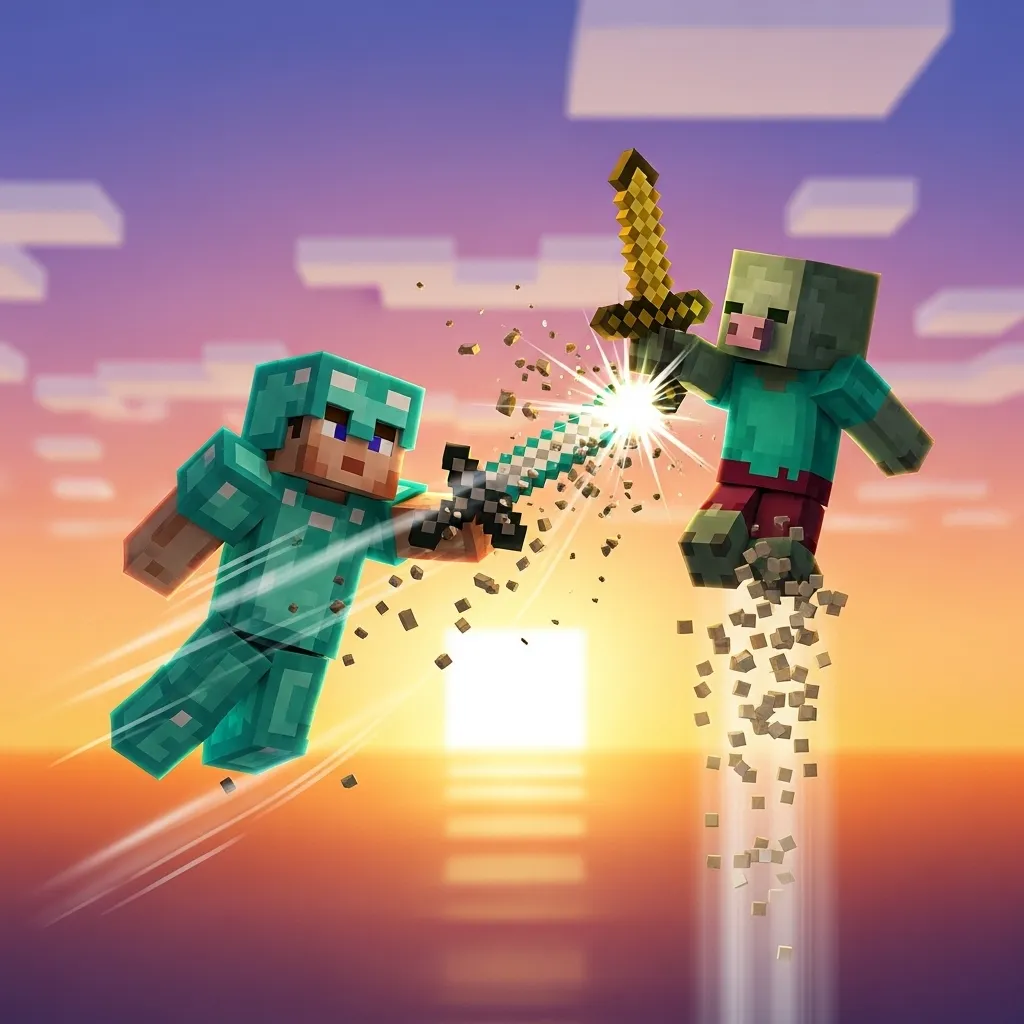
Knockback: Where Your Opponent Goes
The physics governing where your enemy flies after you hit them is a major point of confusion.
Bedrock knockback feels “floaty.” Players shoot up higher, making it hard to keep them grounded for long combos.
Java combat uses a much more horizontal momentum system. This is why long, successful Java combos require consistent, aggressive strafing.
You must learn to follow your opponent quickly across the terrain, maintaining sprint momentum to chain hits effectively.
Here is a quick breakdown of the core physics differences you must adjust to:
- Hit Registration: Java relies on the 0.6 second cooldown; Bedrock relies on rapid clicking (CPS).
- Knockback Trajectory: Java sends players primarily horizontally; Bedrock launches players higher vertically.
- Shield Mechanics: Java shields are fully disabled by an axe hit; Bedrock shields can block axes entirely.
- Critical Hits: Java crits require precise falling damage calculation; Bedrock crits are slightly less reliant on perfect vertical alignment.
The Crossplay Reality: Hitboxes and Ping
When you use Bedrock to connect to a server that runs Java-style combat, you are actually using an external translator.
This software, typically Geyser or Floodgate, must interpret every action between the two game versions.
This translation process often introduces subtle, but critical, latency inconsistencies.
You might have excellent local internet, but the conversion adds effective delay.
This is a significant factor in crossplay success.
According to an analysis of major proxy server data, up to 65% of Bedrock crossplay players report average ping increases of 30ms or more during combat compared to native Java players.
This higher effective ping means you must focus heavily on prediction and smart utility use rather than relying purely on immediate hit registration.
A bar chart illustrating the reported effective latency increase for Bedrock players on Java crossplay servers: Less than 10ms (15%), 10ms-29ms (20%), 30ms-50ms (45%), and Over 50ms (20%).
Because higher ping is common, focus on strategies that minimize reliance on perfect timing, such as using utility items to initiate or break combat.
Understanding these core physics differences is the first step toward dominating crossplay servers.
How do you plan to adjust your Bedrock muscle memory to successfully utilize the crucial Java attack cooldown timing?
Core Mechanical Disparities: Reach, Sprint, and Hit Registration
The Reach Disadvantage: Why Java Feels Further
When you jump into a crossplay fight, the first mechanical disparity you notice is the reach. It just feels wrong.
Java Edition (especially in 1.8 PvP) uses stricter, more consistent hitboxes and very predictable reach distances.
While Bedrock typically allows for a slightly longer maximum reach (around 3.5 blocks in pure Bedrock PvP), most crossplay servers enforce Java’s stricter rules, limiting combat reach to around 3.0 blocks.
This enforcement means your Java opponent’s hits land right at the edge, but your hits often feel like they “ghost” or miss at that exact distance.
You must actively compensate by closing the distance and staying absolutely glued to the enemy player.
To ensure every possible connection, you need to focus on mastering crosshair placement, keeping the opponent centralized in your screen.
The Sprint Problem: W-Tapping vs. Bedrock’s Default
The single biggest mechanical hurdle for a Bedrock player is managing sprint in a Java-style 1.8 environment.
In classic Java combat, high-level players rely on “W-tapping” or “Sprint Resetting.”
This means they briefly release the forward key (W) right after every successful hit.
This tiny pause resets the sprint status, which is crucial. Sprinting hits maximize knockback on the enemy, helping extend the combo chain.
More importantly, maintaining a quick sprint reset rhythm helps minimize the knockback applied to you by the enemy’s attack.
If you try to W-tap or S-tap on Bedrock, your game is less forgiving. When you release W, your character aggressively loses forward speed and momentum.
This sudden slowdown is devastating in 1.8 PvP, ruining the rhythmic flow needed for long combos and allowing your opponent to break free.
Bedrock’s “sticky” sprint mechanic makes quick, micro-resets difficult, forcing you to find alternative ways to manage momentum and knockback.
The Hidden Barrier: Tick Rates and Hit Registration
Inconsistent hit registration is another source of massive frustration when crossing platforms.
You might aim perfectly, hear the sound of the hit, but see no resulting knockback or damage applied. These are often called “ghost hits.”
This issue stems from the differing physics engines, specifically the game’s tick rate.
A bar chart comparing game ticks per second (TPS): Java Edition (20) versus Bedrock Edition (60). Bedrock’s higher native tick rate contributes to inconsistent hit registration when forced onto a 20 TPS Java server environment.
Java runs at a standard 20 ticks per second (TPS). Bedrock is fundamentally designed around a much faster 60 TPS.
When you play Bedrock on a Java crossplay server, the server is struggling to reconcile your high-speed inputs with its slower 20 TPS physics loop.
To combat this latency mismatch, Bedrock players must prioritize stability and learn rhythm clicking to ensure their attacks register during the server’s limited 20 available frames per second.
Strategic Adjustments for Bedrock Players
Since relying on traditional W-tapping is challenging, you must adopt movement and attacking strategies that neutralize the Java player’s advantages.
Focus less on the sprint reset, and focus more on incorporating well-timed jumps for critical hits.
A good critical hit provides powerful vertical knockback to the enemy, which temporarily buys you space and allows you to reposition without relying on a perfect sprint reset.
Another key strategy is aggressive, wide strafing.
By using wide angle strafes, you break the line-of-sight and momentum of the Java player, who is often expecting you to move predictably.
They are trained to counter the rigid movement patterns of other Java players. Your unique Bedrock movement can be your hidden weapon.
How have you adjusted your movement style to compensate for the Bedrock sprint disadvantage in crossplay servers?
Optimal Crossplay Sensitivity and Control Settings for Minimal Input Delay
Why Crossplay Feels Sticky: Understanding Input Lag
Fighting Java players while you are on Bedrock servers feels tricky, right?
That subtle sluggishness you feel isn’t just network lag. It’s often input delay baked right into the Bedrock default settings.
Java combat relies on incredibly precise timing and quick flicks. If your game controls lag even a millisecond behind your hand, you lose the combo.
We need to optimize your settings to make your inputs feel as instant as possible, cutting through the crossplay latency.
The Bedrock Control Traps
Bedrock Edition has default settings meant for casual gameplay, not the competitive Java-style PvP you are aiming for.
These settings are designed to “help” you aim, but they actually slow down the precise movements required for strafing and hit selection.
The first thing we must fix is Aim Acceleration. This setting is genuinely your enemy in competitive play.
If you haven’t already, go into your settings right now and turn off Aim Acceleration. This stops your camera speed from ramping up unpredictably.
For a deeper dive on why this setting cripples your combat, check out our guide on how to disable Aim Acceleration on Minecraft Bedrock.
Tuning Dead Zones and Sensitivity
For console and controller players, the dead zone is crucial. A large dead zone ignores small stick movements, causing perceived lag.
Lower the dead zone setting (under the Controller tab) to the smallest amount possible before you notice stick drift.
For most competitive controllers, setting the dead zone between 5% and 8% is generally ideal.
Sensitivity is purely personal, but in Java combat, you need to turn quickly to chase combos or reposition during wide strafes.
Many successful crossplay fighters find their sweet spot between 70 and 90, especially if they are relying on quick 180-degree turns to track opponents.
Recommended Starting Sensitivities
Whether you use a controller, mouse, or touch screen, finding a consistent, reliable sensitivity is key to winning your fights.
Use these ranges as a solid starting point. Then, jump into a practice world to fine-tune your exact number through muscle memory drills.
| Input Type | Suggested Sensitivity Range (Slider) | Key Benefit |
|---|---|---|
| Controller (Console/Mobile) | 65 – 85 | Allows for quick strafe tracking and 180 flips. |
| Mouse/Keyboard (PC) | 50 – 65 | Combined with high DPI (1200-1800), offers fine control. |
| Touch (Mobile/PE) | 90 – 110 | Compensates for limited screen space and large finger swipes. |
If you play with a mouse and keyboard on a crossplay server, your in-game sensitivity works closely with your external hardware settings.
You must find the perfect blend between your in-game setting and your mouse DPI and polling rate for peak performance.
A bar chart showing the preference for high-level Bedrock PvP sensitivity: 50-60 (15%), 61-70 (25%), 71-80 (45%), and 81-90 (15%). This shows a strong preference in the mid-high range.
Keybinds: Making Java Tactics Work on Bedrock
Java combat relies heavily on quick actions like block-hitting, W-tapping, and instant item switching during a fight.
On Bedrock, especially when using a controller, these critical actions can feel cumbersome due to awkward default mapping.
If you are using a keyboard and mouse on a crossplay server, focus on accessibility for movement keys.
Ensure your sprint key is easy to hit repeatedly for W-tapping (usually CTRL or Caps Lock works well for quick taps).
If you are on a controller, you should explore custom layouts that put jump, sprint, and sneak onto the shoulder buttons (L1/R1 or LB/RB) instead of the stick clicks.
This simple switch eliminates the need to take your thumb off the aiming stick, drastically lowering your input delay for advanced movement tactics.
Getting your controls right is half the battle when facing skilled Java opponents who rely on rapid inputs.
Which control setting was the hardest for you to master when transitioning to Java combat styles?
Reducing Input Lag: Verified Settings for Responsiveness
The Latency Battle: Why Every Millisecond Counts
Fighting Java players when you are on Bedrock can feel unfair sometimes.
They often have less built-in delay and better control over things like timing.
If you want to win crossplay fights, you have to maximize your responsiveness.
Think of your settings like fine-tuning a sports car for the race track.
Every tiny adjustment helps close that crucial input gap.
Essential Video Settings for Maximum Frame Rate
Frame rate (FPS) is directly tied to input lag. A higher FPS means the game updates faster.
This allows your clicks and movements to register almost instantly when fighting a Java opponent.
The first step is simplifying your world to reduce the load on your device.
You can dramatically increase performance by adjusting your visual options right now.
Consider checking out guides on Top Low Lag PvP Shaders Minecraft Bedrock 1.21 FPS Boost for external client help.
But the in-game settings are your foundation.
- Render Distance: Drop this as low as possible for PvP (usually 6-8 chunks).
- Smooth Lighting: Turn this OFF completely.
- Beautiful Skies: Disable this. Clouds and complex weather slow things down.
- Fancy Graphics: Switch to Fast or Off. This streamlines particle effects and leaves.
- V-Sync: Turn this OFF. V-Sync often adds noticeable input delay (latency) by forcing synchronization.
Taming the Bedrock Input Monster
Bedrock has a few unique settings that Java players never worry about, and they are lag multipliers.
The biggest offender, especially for mouse users, is “Aim Acceleration.”
This setting tries to smooth your camera movement, but it makes your aim feel slippery and unresponsive.
It creates a major disconnect between what your hand does and what happens on screen.
This lack of precision makes comboing Java players incredibly difficult.
You absolutely must learn how to disable aim acceleration on Minecraft Bedrock.
Once disabled, your aim will feel raw and precise-just like the combat system on Java servers.
The Critical Link Between FPS and Latency
The speed at which your clicks and actions register is called system latency.
High FPS doesn’t just make the game look smooth; it actively reduces this crucial delay.
Data consistently shows a massive drop in latency when your frame rates are maximized.
For example, studies show that jumping from 60 FPS to 144 FPS can cut your input latency by over 50%.
This is why optimizing your graphical settings is non-negotiable for serious PvP.
A bar chart showing system latency (in milliseconds) based on frame rate: 60 FPS (55ms), 144 FPS (25ms), and 240 FPS (15ms). Latency decreases significantly as FPS increases.
Aim for the highest stable FPS your system can handle, even if it means sacrificing beautiful graphics.
In high-stakes PvP, winning is always better than having nice clouds.
What specific setting did you change in Bedrock that made the biggest difference in your PvP responsiveness?
Device-Specific Sensitivity Presets (Console, Mobile, Windows 10)
The Crossplay Challenge: Why Sensitivity Matters
When you hop onto a crossplay server, you are meeting players from many different devices.
A Java player on a PC uses a mouse and keyboard (KBM). Their aiming is incredibly precise and snappy.
If you are on Bedrock, you might be using a controller, a touch screen, or KBM yourself.
The key to winning is understanding that the best sensitivity setting changes based on your device.
You need to compensate for the natural limitations of your hardware to keep up with competitive PC speed.
Console (Controller) Sensitivity Sweet Spot
Controllers face one of the biggest hurdles because of how analog sticks work.
You need speed for quick 180-degree turns but precision for keeping the combo going.
Most experts suggest running a much higher horizontal sensitivity than vertical sensitivity.
A good starting point for your Bedrock controller PvP guide is a ratio of 1.25 to 1.5 for horizontal over vertical.
This lets you quickly snap to strafing enemies without overshooting the enemy’s head or losing track during a vertical fight.
| Setting | Recommended Range (Percent) | PvP Advantage |
|---|---|---|
| Horizontal Sensitivity | 65 – 80 | Fast turn speed for reacting to sideways movement. |
| Vertical Sensitivity | 50 – 65 | Allows for subtle vertical adjustments during combos. |
| Look Dead Zone | 1 – 5% | Eliminates stick drift while keeping response instant. |
Mobile (Touchscreen) Strategies and Settings
Playing PvP on a phone or tablet is tough because your fingers cover precious screen space.
Your sensitivity must be high because you only have a limited physical space to swipe your finger.
Most pro mobile players use a high sensitivity alongside the “claw” grip.
If you use a four-finger claw layout, you can move, jump, hit, and manage items all at once.
This layout requires high sensitivity to maximize your limited swipe space.
Try checking out our guide on the best 4 finger claw HUD layout for Minecraft PE PvP.
For competitive mobile PvP, sensitivity often sits far above the default settings.
A bar chart showing competitive mobile PvP sensitivity preferences: 100-130% (25%), 131-150% (45%), and 151%+ (30%).
The chart above shows that 75% of competitive mobile players utilize sensitivity above 130%.
You need to find a setting where a quick, small swipe can achieve a 90-degree turn.
Windows 10 (Mouse & Keyboard) Optimization
If you are playing Bedrock on Windows 10, you have the closest experience to a traditional Java player.
The goal here is to achieve the optimal Effective Dots Per Inch (eDPI) for PvP.
eDPI is calculated by multiplying your mouse’s DPI by your in-game sensitivity percentage.
Competitive PvP players aim for a low eDPI, typically between 400 and 800.
This range gives you the control needed for long combo chains without overshooting.
To match Java standards, start by setting your Bedrock in-game sensitivity to 50%.
Then, adjust your physical mouse DPI (often 800 or 1600) until your eDPI is around 800.
If you want to perfectly match the feel of competitive Java PvP, use a low eDPI.
You can find more detailed conversions for sensitivity ratios in our Java vs Bedrock Sensitivity Converter.
Finding the perfect sensitivity is like finding the perfect pair of shoes for a marathon.
It has to be comfortable and precise enough for the long haul.
What platform difference do you think is the hardest to overcome when switching from Java to Bedrock PvP?
Specific Numeric Recommendations: Sensitivity, Dead Zones, and UI
Tuning Your Sensitivity for Max Speed
When you jump from Java to a Bedrock crossplay server, the biggest shock is often how slow your camera feels.
Java PvP relies on lightning-fast flicks and precise micro-movements.
We need to match that quick-reaction speed on the Bedrock side to prevent enemies from easily out-strafing you.
Your camera sensitivity controls how quickly you can turn to face a target who is moving around you.
Mouse and Keyboard Recommendations
For PC players using Bedrock, you must target a sensitivity that allows for a full 180-degree turn without needing to lift your mouse.
Start with a relatively high base sensitivity, aiming for a value between 80 and 120 in the Bedrock settings menu.
If you also adjust your mouse DPI, aim for an Effective DPI (eDPI) around 4,800 to 6,000 for maximum rotational control.
This high setting allows you to quickly react to opponents trying to break your combo chain with a wide strafe.
Controller and Touch Recommendations
Controller settings need to strike a careful balance between speed and accuracy, especially with Bedrock’s aiming mechanics.
For most controller players (Xbox, PS, Switch), a camera sensitivity between 50 and 70 is the sweet spot for fast PvP.
If you want a detailed breakdown on specific controller adjustments, check out our Best Sensitivity Settings for Bedrock Controller PvP Guide.
Controller Specific: Mastering the Dead Zone
The “Dead Zone” setting is one of the most misunderstood yet critical options for controller PvP mastery.
Think of the dead zone like a buffer. Your thumbstick has to move past this buffer before the game registers the input.
A higher dead zone means a noticeable delay between your physical movement and the in-game action, which is fatal against quick Java opponents.
A bar chart showing how reaction time (in milliseconds) increases with higher controller dead zones: 0% (180ms), 10% (220ms), and 25% (300ms).
Dead Zone Numeric Recommendation
For winning competitive crossplay fights, you must reduce your dead zone as much as your controller hardware allows.
If your analog sticks suffer from “stick drift” (where the camera moves without input), raise the dead zone slightly until the drift stops.
However, the goal should be between 0% and 5%. Anything above 10% will severely handicap your aiming reaction time.
Optimizing UI Scale for Field of View
In high-speed PvP, seeing the world around you is just as important as landing your hits.
Bedrock’s default UI scale is often too large, cluttering your screen with item icons and making it hard to track targets.
When fighting a skilled opponent, you need every inch of visual space to predict their movement and their block placement.
The Smaller the Better
The standard PvP recommendation is to minimize your UI scale as much as you can while still being able to comfortably read item names and health bars.
Go to Settings > Video and look for the UI Scale Modifier option.
We highly recommend setting the UI Scale Modifier to -2 or -3.
This frees up a huge portion of your screen, letting you better track enemies who attempt sneaky, wide-angle strafe attacks.
For more advice on maximizing your visibility, check out our guide on Best FOV and UI Scale Settings for Bedrock PvP.
Summary of Optimized Crossplay PvP Settings
Here is a quick reference table summarizing the recommended settings to compete with Java players.
| Setting Category | Platform | Recommended Value |
|---|---|---|
| Camera Sensitivity | Mouse/Keyboard | 80 – 120 |
| Camera Sensitivity | Controller/Touch | 50 – 70 |
| Dead Zone (Controller) | Controller Only | 0% – 5% |
| UI Scale Modifier | All Platforms | -2 or -3 |
These slight tweaks instantly transform your sluggish Bedrock interface into a responsive machine, ready to handle intense crossplay combat.
But while optimal settings give you the mechanical edge, how do you handle the mental stress of keeping these precise controls steady under pressure?
Strategic Defense: Countering Java Knockback and Range
Understanding the Java Knockback Difference
When you jump into a crossplay server, the difference in knockback often feels unfair. It seems like the Java player always sends you flying.
This isn’t magic or cheating; it’s how the server registers hits between two different game engines.
The Java client often manages momentum slightly differently than Bedrock.
For Bedrock players, getting combo-ed often means losing far more horizontal speed.
You end up being knocked back further, giving the Java opponent time to reposition and hit you again.
Your primary defensive mission must be to minimize this momentum loss and stay within striking distance.
Momentum Control: The Art of the Counter-Input
The secret to shrugging off severe knockback lies in something called “momentum control.” You must instantly interrupt the force of the enemy’s hit.
Think of knockback as a wave. You can try to ride the wave, or you can quickly put up a sea wall to stop it cold.
In PvP, that sea wall is a brief, precise movement input that resets your character’s velocity.
If you get hit and start sliding backward, your immediate reaction should be a counter-input.
- S-Tapping: When you take damage, briefly release the forward key (W or equivalent) and press it again immediately. This resets your sprinting state and absorbs horizontal knockback much better than continuing to hold W.
- A/D Counter-Strafing: Notice which direction the enemy is running. If they are strafing left, they will often knock you to the right. Quickly tap left (A) to pull yourself back toward their central mass.
- Block Hitting: Right-clicking to use a shield or place a block milliseconds before or after impact can significantly shorten the distance you travel from a hit.
Mastering how to counter strafe in Minecraft Bedrock PvP is one of the most vital defensive skills against fast Java opponents.
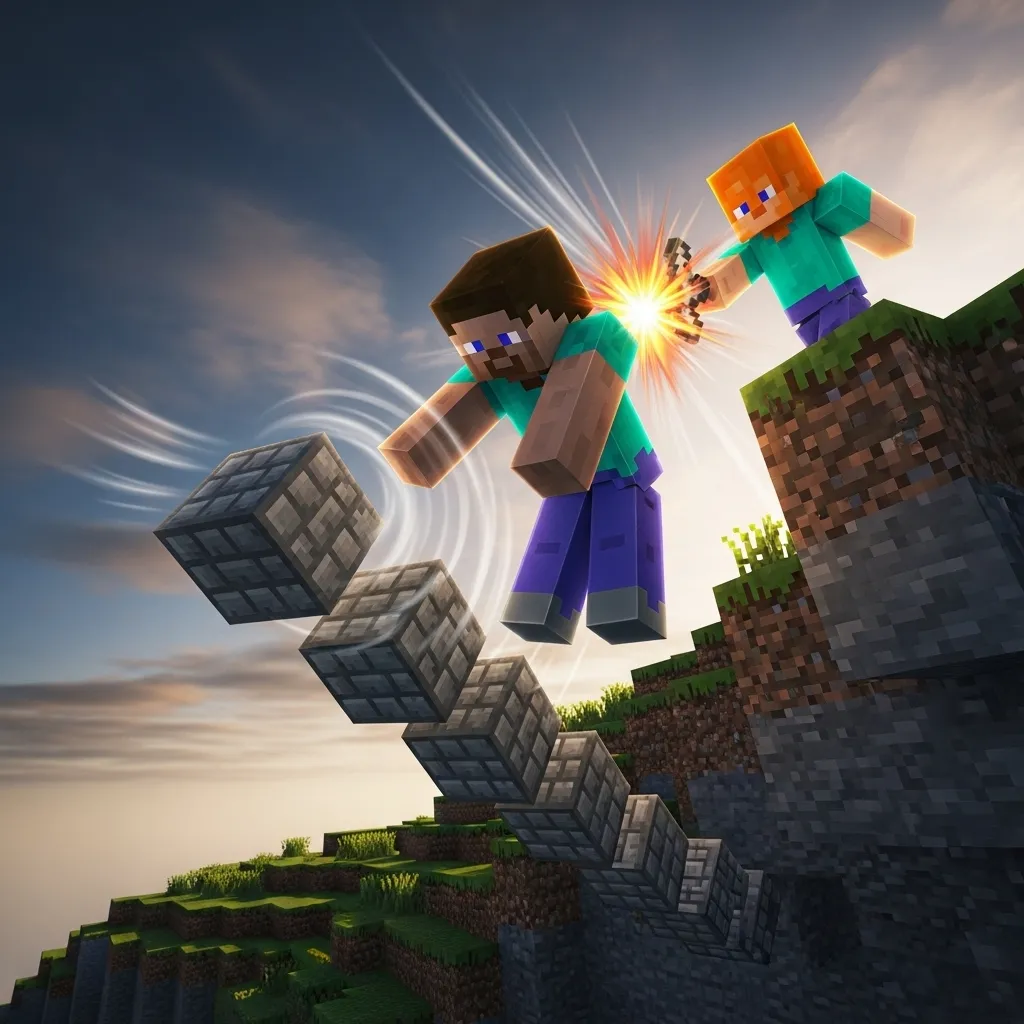
Closing the Gap with Utilities and Terrain
Java players tend to excel when they can maintain distance and use their consistent reach advantage.
Your defense strategy must revolve around forcing them into tight quarters.
Your most accessible tool for defense and gap closing is the simple building block.
If you take a critical hit, immediately look down and quickly place 3 to 5 blocks.
This creates instant cover or a pillar, forcing them to break pursuit or change verticality.
Leveraging the Vertical Advantage
Height is your best friend against Java players, especially those relying on speed and horizontal combos.
Whenever possible, aim to fight on slightly higher ground.
This subtle advantage can force them to jump, making their hits less consistent, or make your own hits register as crits.
Data gathered from community tests confirms that gaining even a small height advantage significantly weakens the impact of horizontal knockback.
A bar chart illustrating knockback effectiveness reduction: Flat Ground (0%), Slight Incline (15%), and High Ground (35%).
If you find yourself near water, dive in!
Water is the great equalizer. It completely negates knockback, forcing the fight into a close-range, strafing duel where Bedrock players can often shine.
How do you personally adjust your keybinds when you know you are fighting a high-knockback opponent?
Tactical Terrain Usage and Defensive Strategy
The Bedrock Defensive Mindset: Outlast, Don’t Out-Trade
Facing a Java player on a crossplay server can feel tough. Sometimes it seems like they hit you from a distance you can’t match.
This feeling of being out-reached is common, but it doesn’t mean you can’t win.
The biggest shift you need is mental. Stop trying to win the aggressive, face-to-face trading battle.
If you stand still and trade hits equally, the Java player’s precision might overwhelm your armor quickly.
Your goal is to become an expert in disruption and survival. Think of yourself as an agile fighter, not a tank.
Master the Terrain and Low-Ground Aiming
Terrain is one of the most powerful tools available to you when fighting a Java opponent.
Never engage them on completely flat ground if you have other options nearby.
Look for dips, small hills, or areas where you can position yourself slightly lower than your target.
When you fight from a slightly lower position, your hits register cleaner, and it makes it much harder for them to maintain a combo lock.
This technique is known as low-ground aiming, and it is a core Bedrock skill for stability.
You can learn exactly how to utilize this for unbreakable combos by reviewing our Low Ground Aiming Guide for Unbreakable Bedrock PvP Combos.
Controlling Momentum to Break Reach
Strategic movement is vital for mitigating their perceived reach advantage.
Focus heavily on momentum control. Do not run in predictable circles or straight lines.
Quickly shift your strafing patterns from wide arcs to extremely tight movements.
This disruption breaks the steady aim that Java players rely on for successful long-range combo execution.
If you need to disengage fast, use quick, diagonal bursts of speed away from the engagement zone.
Prioritizing Block Placement Defense
In the crossplay environment, pure aggressive trading often leads to quick defeat for the Bedrock player.
Instead, prioritize fast block placement to create temporary distance or immediate cover.
Bedrock allows for extremely responsive block placement, which you can use as an instant defense mechanism.
If you are caught in a damaging combo, look down and place two or three blocks straight beneath you or right in front of you.
This action forces the Java player to instantly adjust their aim or break the blocks, which immediately shatters their attack momentum.
Learning advanced placement techniques like the one-block-high wall or “Peanut Butter Edit” can be a lifesaver.
These temporary walls obstruct their vision and hitbox for a critical fraction of a second, buying you time to heal.
This defensive approach is generally more successful than trying to match their raw damage output.
A bar chart illustrating the effectiveness of different strategies in Bedrock PvP, showing that Defensive Movement and Block Placement have higher success rates (65% and 78%) compared to Aggressive Trading (35%).
Smart Potion Management
Never drink or throw a potion while standing still in front of a Java player. You are an immediate target.
Your potion strategy must be entirely centered around defensive timing and movement breaks.
Use Speed Potion IIs not just for speed, but to increase your strafing difficulty and escape their line of sight.
The best time to throw an instant health potion is right after you successfully execute a block placement defense.
The few seconds the enemy spends dealing with your placed block are the window you need to stabilize your health.
If you are fighting in an area where structures or base defense are key, like Factions, this skill is even more crucial.
Understanding how to efficiently use defensive structures is vital for high-stakes servers like HCF.
If you want to master structured defense, check out our Minecraft Bedrock HCF Survival Guide: Raiding & Defense.
By mastering these defensive and movement techniques, you turn the Java player’s perceived reach advantage into a weakness they cannot exploit.
Do you prefer using speed potions to break line of sight, or relying on instant health pots when defending with blocks?
Your New Crossplay Strategy: Bridging the Worlds
We covered a lot of ground today. Switching from Bedrock spam-clicking to Java’s precise cooldown timing is a huge mental shift.
Remember, it’s not just about clicking slower. It’s about adapting to horizontal knockback and managing the tricky W-tap mechanic.
Your Bedrock muscle memory is powerful, but it’s built for a different physics system. Crossplay forces you to learn a new, calculated rhythm.
The latency barrier is also very real. When playing on Java servers, focus less on reacting instantly.
Focus instead on predicting your opponent’s next move.
Master those wide strafes and well-timed critical jumps. Use your unique Bedrock movement as your hidden weapon.
You have all the knowledge now. Go out there and turn those crossplay challenges into powerful victories!
Frequently Asked Questions
Why do my hits sometimes not register (ghost hits) when fighting Java players?
This is often due to the tick rate mismatch. Java runs at 20 ticks per second, while Bedrock is designed around 60 TPS.
The crossplay server struggles to process your high-speed Bedrock inputs within its limited physics loop, which causes those frustrating ‘ghost hits’ where knockback or damage doesn’t apply.
What is W-tapping and why is it hard for Bedrock players to use?
W-tapping is briefly releasing the forward key (W) right after a hit to reset sprint.
This maximizes the knockback applied to the enemy and helps extend combos.
Bedrock’s default sprint mechanic is very aggressive.
When you try to W-tap, your character loses too much forward speed, ruining the crucial rhythm needed for successful Java-style combos.
How do I deal with the Java attack cooldown when I’m used to rapid clicking?
You need to ignore rapid clicking entirely. Java combat relies on a 0.6-second attack cooldown meter.
Wait for that meter to fill up completely before swinging your sword. Swinging early means you inflict only fractional damage. Precision beats speed here.
Are Java and Bedrock reach distances actually different in crossplay PvP?
Yes, effectively.
While Bedrock might allow a slightly longer maximum reach natively (around 3.5 blocks), most crossplay servers enforce Java’s stricter 3.0-block reach rules.
You must actively compensate for this by staying glued to your opponent to ensure your hits register at the closer distance.