Want to dominate your server?
Fighting on a mount changes everything.
It’s fast, chaotic, and totally thrilling.
Whether you pick a speedy horse or a tactical camel, mastering mounted combat is your ticket to winning.
Let’s look at the best strategies for Bedrock Edition.
Key Takeaways
- Prioritize horses with high speed and jump stats for effective hit-and-run tactics.
- Utilize the camel’s height and dash ability for superior spacing and reach advantages.
- Master the timing of mounted critical hits to deal massive burst damage.
- Equip Riptide Tridents or fast swords to maintain offense while moving at high speeds.
- Counter dismount attempts by using defensive blocks and maintaining wide movement circles.
Optimizing Bedrock Mounts: Horse Stats and Camel Selection
The Horse: Speed, Jump, and Health Triad
Choosing a horse for Bedrock PvP means betting on raw speed and mobility.
A good horse is like a highly tuned sports car; you need to look for three critical stats: maximum speed, high jump height, and decent health points (HP).
In combat, speed lets you kite enemies and quickly cover ground, while jump height helps you clear obstacles and catch opponents off guard.
Horse stats are randomly generated. Finding the perfect beast takes serious dedication and often involves selective breeding through dozens of attempts.
Horse Stat Requirements for PvP
A low-jump horse will get stuck constantly. This is a death sentence in fast-paced mounted PvP.
Here is a quick look at the stats you should aim for when scouting or breeding a warhorse:
| Metric | Ideal Range | PvP Benefit |
|---|---|---|
| Speed | 10.5 – 14.2 blocks/s | Maximum escape and chase potential. |
| Jump Height | 4.9 – 5.5 blocks | Clearing fences, small cliffs, and water. |
| Health | 24 – 30 HP (12-15 hearts) | Tanking a few unexpected critical hits. |
The closer you get to the upper range of speed and jump, the more valuable your mount becomes. These stats give you a huge advantage.
The Camel Advantage: Height and Dash
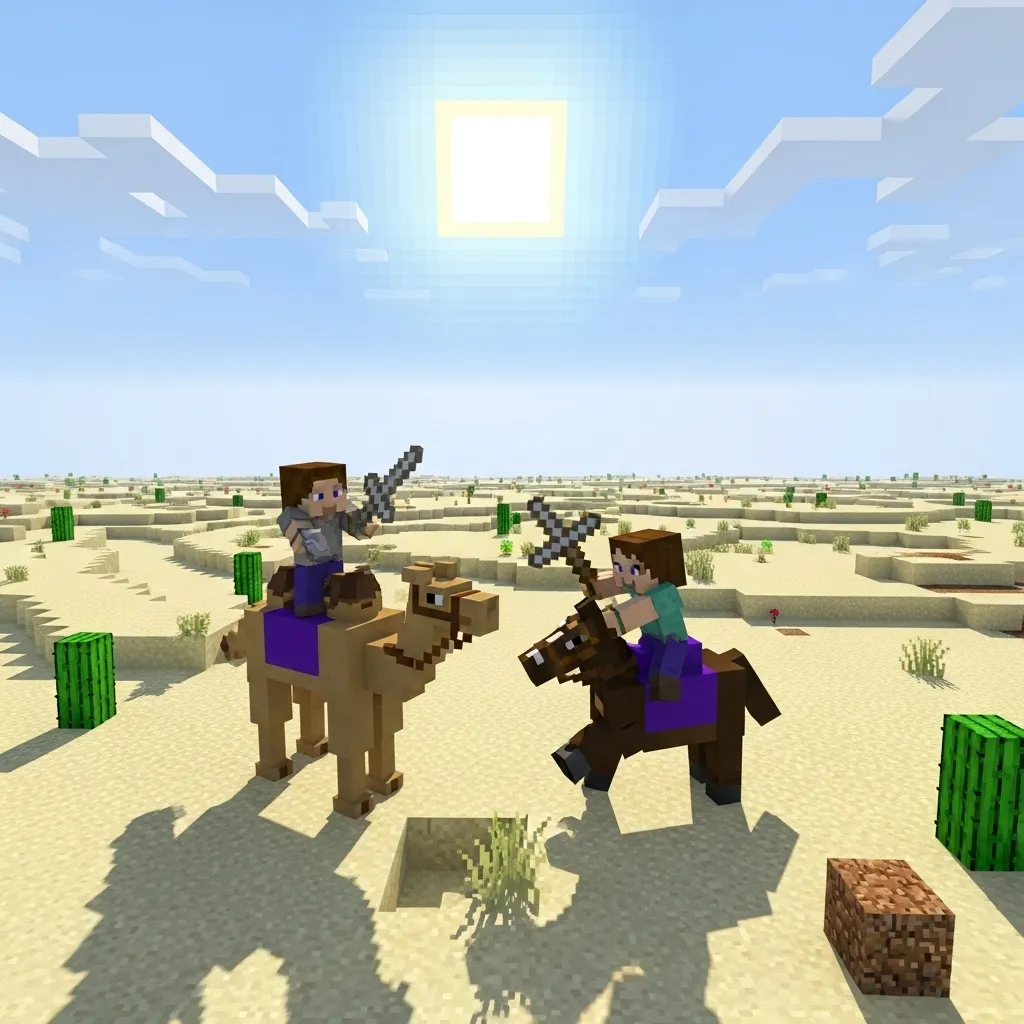
The camel is the new kid on the block, bringing unique tactical benefits that horses simply cannot match.
Camels are noticeably slower than a top-tier horse, so don’t choose one if pure speed is your main objective.
Their main strength is their height. When you ride a camel, you sit much higher up than on any other mount.
This height gives you a major reach advantage over enemies fighting on foot, letting you land hits while they struggle to target you.
The Camel’s Dash Mechanic
The camel also has a powerful dash ability. It’s like hitting a quick nitro button for a short, intense burst of speed.
This dash is crucial for repositioning or closing a gap quickly when enemies try to retreat, or when you need to master advanced vertical knockback on them.
The dash recharges relatively fast, giving you consistent burst mobility.
Mastering the dash timing separates a casual camel rider from a mounted combat expert.
Another major factor is safety: when you are mounted on a camel, zombies and most hostile ground mobs cannot reach you.
Choosing Your Weapon Platform
So, which mount is the right choice for your specific PvP strategy?
If your goal is pure flanking, hit-and-run tactics, or covering large distances rapidly, always invest time in finding a max-speed horse.
This mobility is essential for servers with large, open maps, like Factions and Anarchy servers.
If you anticipate closer, tighter combat where reach and dash utility matter, the camel is a superior choice.
Think of the horse as a precision weapon-fast and focused. The camel is a sturdy utility tool-reliable and protective.
A pie chart showing player preference for 1v1 mounted PvP: 60% prefer the High-Speed Horse, and 40% prefer the Utility Camel.
This community preference data shows that 60% of competitive players still lean toward the raw speed and evasion offered by a well-bred horse.
However, the camel’s ability to avoid ground damage and host two riders is quickly changing the meta in team scenarios.
What kind of Bedrock PvP warrior are you-a speed demon on a horse, or a utility master on a camel?
Camel Positional Warfare: Utilizing Reach and Dash Exploits
The Camel’s Natural Advantage
Riding a camel in Bedrock PvP is like bringing a tall, powerful ally to the fight. You immediately gain a significant height advantage over foot soldiers.
Because you sit so much higher, your natural attack reach is extended downward and slightly forward. This changes the dynamics of the fight completely.
Your goal is “poking”-connecting your hits while maneuvering just outside your opponent’s standard melee reach.
The vertical edge forces the enemy to adjust their aim high. This often results in wasted attacks or hits only landing on the camel itself, not you.
Mastering the Dash Exploit
The Camel’s Dash ability is the ultimate secret weapon for positional warfare. It is much more than just a speed boost on flat ground.
You should view the Dash as a tactical tool for instant distance control, or “spacing,” in intense engagements.
If you find yourself caught in a bad position or taking heavy damage, trigger the Dash instantly to disengage and create separation.
This sudden burst of speed forces your opponent to stop their combo chain and switch their focus from attacking to chasing.
Conversely, the Dash is perfect for sudden engagements.
If your enemy uses an ender pearl or missteps, hit the Dash to instantly close the gap for a critical finishing blow.
Camel Movement Comparison Table
Understanding the difference between the camel’s movement modes is vital for strategic positioning.
| Movement Type | Approximate Top Speed (m/s) | Primary PvP Role |
|---|---|---|
| Player Sprinting | 5.6 | Sustained Engagement |
| Camel Standard Walk | 4.7 | Maintain Range/Kiting |
| Camel Dash (Burst) | 12.0 | Instant Disengage/Crit Gap Close |
Positional Tactics: Kiting and Circling
To win with a camel, you must control the distance and the flow of the battle. Do not get locked into a direct, static melee brawl.
The best tactic is “kiting.”
You land your powerful downward hits, then use your movement advantage to retreat just enough so the enemy can’t easily return the favor.
Always move in wide circles when possible.
This prevents your opponent from locking down your hitbox and gives you clear angles for your extended reach attacks.
If the enemy uses advanced techniques like strafing to confuse your camel’s large movement profile, you must adapt quickly.
It helps greatly to learn how to counter strafe in Minecraft Bedrock PvP, even when you are mounted, to keep your attack cursor locked on target.
Mastering this positional dance turns the camel from a slow target into a high-reach demolition tool.
Do you prefer using the camel’s reach to keep your enemies far away, or do you rely on the dash for aggressive, close-range critical strikes?
Mounted Combat Mechanics: Spacing, Timing, and Critical Hits
The Speed Difference: Why Spacing Changes
Mounted combat fundamentally changes the dynamics of PvP. You are no longer fighting on foot; you are now moving at high speed.
A fast horse can easily move twice as quickly as a player sprinting on the ground.
This massive speed boost makes traditional techniques, like circling your opponent, nearly impossible.
Instead, mounted PvP is less of a duel and more of a synchronized joust.
A bar chart comparing movement speeds: Player Sprinting (5.6 m/s), Average Horse Speed (9.3 m/s), and Fastest Horse Speed (14.2 m/s).
Spacing: The Art of the Jousting Pass
Spacing is all about distance and anticipation. When you are moving this fast, your goal is to maximize your hits during the brief window you are in range.
Think of it as two trains passing each other. You have milliseconds to strike.
The best strategy is the jousting pass: charge toward your target, line up your hit, and continue moving past them.
You must know the exact range of your weapon and aim for maximum reach, which is critical when the opponent is moving rapidly in the opposite direction.
To really master how velocity affects your range and positioning, you should study advanced spacing techniques used even in foot combat.
Timing: The Hit-and-Run Rhythm
Since you are on Bedrock, you don’t worry about the attack cooldown meter.
The timing mechanic here isn’t about weapon charge; it’s about movement recovery.
You must time your initial hit to give your opponent maximum knockback, sending them far enough away to safely circle back for a second pass.
If you miss or fail to create distance, you might accidentally stop your horse or get stuck in a bad close-range exchange, where the horse becomes a huge target.
The Quick Remount: A pro move involves jumping off your horse just before collision to get an optimal angle, hitting the opponent, and then quickly remounting to escape the counter-attack.
This maneuver requires superb keybind mastery and practice.
Critical Hits from Horseback
Critical hits in Minecraft happen when you strike an entity while you are falling, usually after a jump.
On foot, you jump, hit, and land. On a horse, things are slightly different because the horse controls the vertical movement.
You can land critical hits from horseback in two primary ways.
- The Jump Peak Crit: Make your horse jump (by pressing the jump key). As the horse starts to descend from the highest point of its jump, strike the enemy.
- The Fall Damage Crit: If you ride off a ledge or a steep slope, you can score crits the entire way down until you hit the ground. This works because you, the rider, are technically falling.
A successful mounted critical hit deals 50% extra damage, making it essential for bursting down tough opponents in heavy armor.
Remember that horse jumping is often less predictable than your own jumps. Practice this timing until it becomes muscle memory.
Do you prioritize the speed of a horse for mobility, or do you prefer the steady control of standard ground PvP?
Essential Loadouts and Anti-Dismounting Counterplay
Optimizing Your Mounted Combat Loadout
Getting on a horse or a camel gives you a massive speed and height advantage in PvP.
But this advantage is fragile unless your gear supports your mounted strategy.
Think of your mounted loadout as two separate elements: the rider and the animal. Both need specialized gear to survive a heavy fight.
Rider Gear: Survivability and Reach
As the mounted player, you are a bigger, more visible target. Your armor needs to focus heavily on damage mitigation.
Netherite armor with Protection IV is always the best foundation, but consider switching out a few pieces for specialized protection.
Stacking Blast Protection on your leggings or boots helps you counter utility items.
Opponents often try to use explosions like Wind Charges or Anchor explosions to force you off the mount.
Weapon Strategy for the Saddle
You need weapons that can be used effectively while sprinting. Traditional melee combat is important, but options that utilize movement are crucial.
The Trident is king in mounted Bedrock combat. If you have Riptide, you can use the rain or water to launch yourself instantly for massive surprise attacks.
A secondary weapon should be a sword for rapid, low-cooldown swipes, which are ideal for keeping enemies away from your mount’s hitbox.
Axes are also excellent, primarily used to disrupt shield users who try to block your charge and wait for a dismount opportunity.
| Weapon | Primary Focus | Mounted Advantage |
|---|---|---|
| Trident (Riptide) | Mobility & Burst Damage | Instant directional change and critical hits. |
| Sword | Rapid DPS | Fast attack speed for continuous pressure while circling. |
| Axe | Defense Disruption | Used to disable shields before a heavy charge attack. |
The Critical Skill: Anti-Dismounting Counterplay
The number one goal of your opponent is to knock you off your mount. When you dismount, you lose momentum, speed, and often suffer fall damage.
To win consistently, you must master the defensive tactics that keep you planted firmly in the saddle.
Maintaining Spatial Awareness
Bedrock combat registers collisions very quickly. If your horse runs into a wall or a tree trunk, even briefly, you risk being dismounted.
Stick to open terrain. Use your horse’s speed to stay in wide circles around your target, forcing them to chase you rather than setting up traps.
Never let the enemy corner you in an area where your mount cannot maneuver freely.
Immediate Defensive Utility Use
When an opponent commits to dismounting you, they often rely on burst damage or high knockback.
You need to be ready to use defensive items instantly.
If you take a heavy hit that results in high vertical knockback, quickly looking down and placing a block can stop your fall and keep your momentum going.
A technique often used is quick pillar placement, sometimes similar to peanut butter edit block placement, to block incoming projectiles or break line of sight immediately.
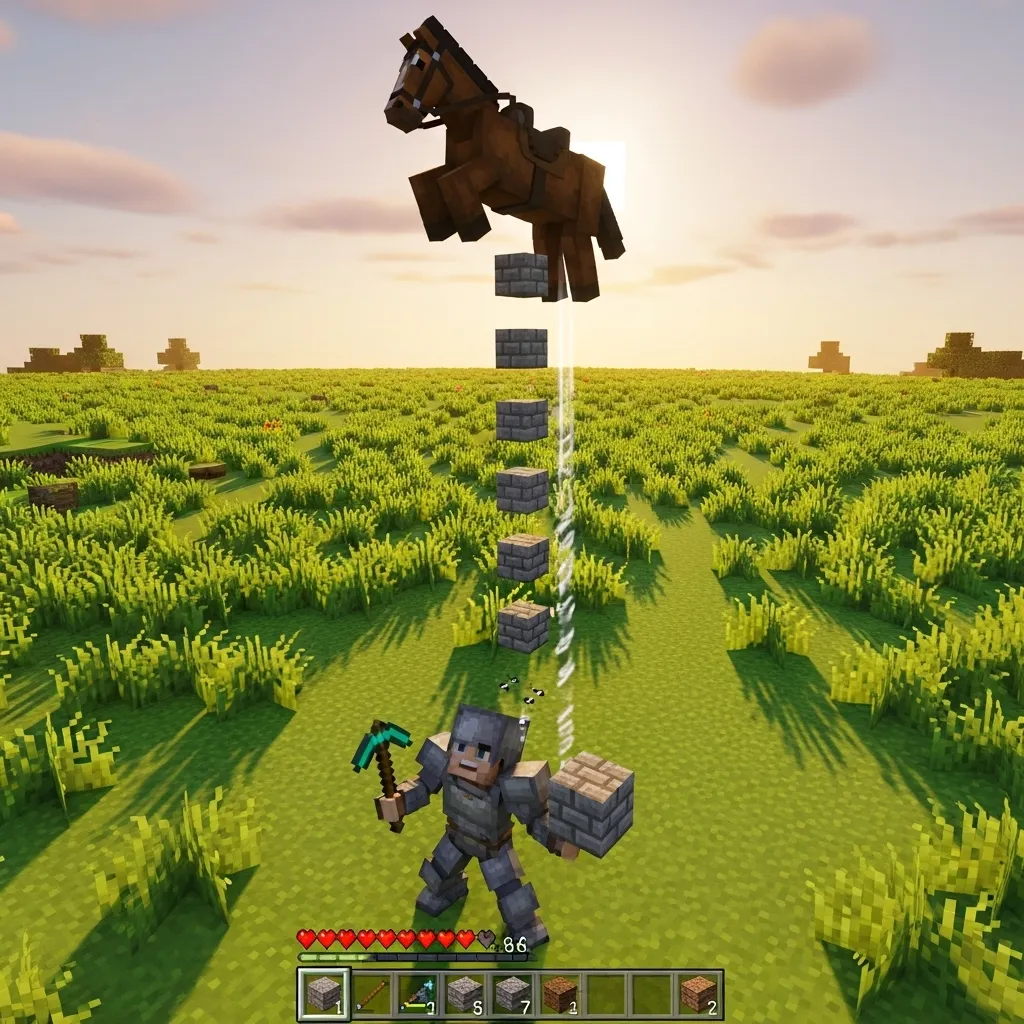
Ender Pearls are invaluable. If you get forcefully dismounted and land away from your horse, pearl away to a safe spot immediately to heal and re-strategize.
Understanding Dismount Methods
Knowing how enemies try to dismount you helps you predict their attacks.
They usually rely on items that provide unexpected vertical knockback or massive force.
A bar chart illustrating the most common methods used by opponents to force a dismount: Punch Bow/Fist (35%), Wind Charge/Explosion (30%), Ender Pearl Block (20%), and Lava Bucket Trap (15%).
Focus your defensive practice on countering these specific threats.
Given that horses in Bedrock PvP have unique hitboxes and movement quirks compared to Java, consider how increased mobility factors into your decision-making when choosing between a Riptide Trident and a Sharpness V Sword.
Choosing Your Perfect War Platform
Deciding between the horse and the camel truly comes down to your personal PvP style and the specific battlefield you are fighting on.
If you crave pure, unmatched speed for rapid flanking and hit-and-run tactics, breeding a perfect horse is absolutely worth the effort.
But don’t underestimate the camel. Its tactical height advantage and powerful dash turn it into a defensive platform for positional warfare.
You need to decide what you are leveraging: maximum velocity and evasion, or extended reach and burst spacing?
Test both mounts extensively. Find the one that feels like a natural extension of your own combat instincts, and you will dominate the Bedrock meta.
Frequently Asked Questions
Which mount provides better sustained speed for escaping, the horse or the camel?
A high-stat horse is significantly better for sustained speed and rapid escapes. A perfect horse moves much faster than a camel.
The camel relies purely on its Dash ability for short, intense bursts of mobility.
What are the essential stats a horse needs for mounted Bedrock PvP?
You must prioritize maximum speed, aiming for 10.5 to 14.2 blocks/s. High jump height (4.9 to 5.5 blocks) is also critical to prevent getting stuck.
Why is the camel’s height considered a tactical advantage?
Riding high on a camel gives you a major reach advantage over opponents on foot. You can land hits while they struggle to target you successfully.
How should I use the camel’s Dash ability effectively in combat?
Use the Dash as a tool for instant spacing or gap closing.
Trigger it to rapidly disengage when taking damage, or to instantly close the distance for a critical finishing blow.