Think the Riptide enchantment is just for swimming? Think again. In Bedrock PvP, your trident is the ultimate mobility tool that beats sprinting every time.
Ready to stop being a target and start dominating the skies? Let’s master advanced movement.
Key Takeaways
- Riptide III offers 3.5x more velocity than level I for massive speed.
- Master the Water Bucket Launch to fly instantly on flat ground.
- Use high sensitivity settings to snap your aim for vertical escapes.
- Bedrock’s Auto-Fly Loop lets you chain launches by holding the throw button.
- Use Riptide bursts to break momentum and land unexpected critical hits.
Mastering Riptide Movement in Bedrock PvP
The Power of Riptide: Mobility is Everything
The Riptide enchantment is not just for swimming.
In Bedrock PvP, it transforms your trident into the ultimate mobility tool, far surpassing sprinting or even Elytra takeoff in specific situations.
If you master Riptide, you stop being a simple target and start becoming an unpredictable threat.
Since Bedrock physics are very fluid, you can reach incredible speeds and heights quickly, making it essential for advanced players.
The Critical Water Element (Wet Activation)
Riptide only works when you are wet. This means standing in water, having rain fall on you, or, most importantly, using a water bucket.
The ability to instantly place and pick up a water source is the secret to high-level Riptide movement on demand, even on flat ground.
If you are serious about Riptide PvP, your water bucket placement must be flawless and nearly instantaneous.
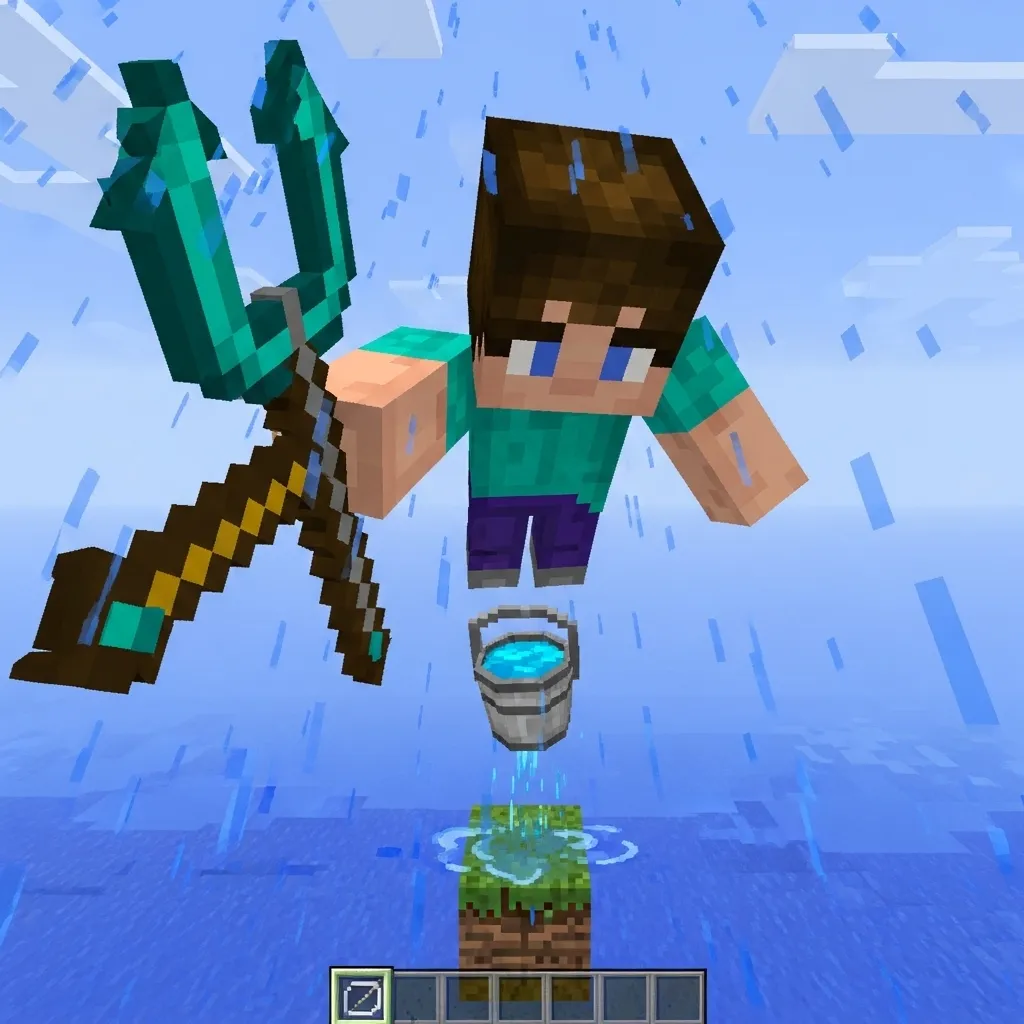
The Riptide Water Bucket Launch (R-WBL)
This is the bread and butter of aggressive Riptide maneuvering.
It allows you to gain vertical distance instantly, useful for escaping combo chains or repositioning above an enemy.
The timing is tight, but the concept is simple:
- Initiate the trident throw (Riptide).
- As you begin launching, quickly place a water block beneath your feet.
- Cancel the water block placement right after activation (if desired) or use the block to slow your descent later.
This technique is vital for initiating quick, high-damage drop attacks or disengaging from a fight when your health is low.
Learning this helps you master the advanced vertical knockback and spacing techniques that dominate the late-game fight.
Advanced Movement Strategies
Vertical Jousting and Evasion
Use Riptide III to launch straight up.
You can quickly turn the tables by launching over an opponent and immediately looking down to throw the trident and strike them from above.
This verticality makes traditional horizontal aiming much harder for your opponent.
If they try to follow, they are usually too slow or will misjudge the landing.
Momentum Breaking
Sometimes you need to suddenly stop or change direction.
When you activate Riptide, you gain incredible momentum.
If you cancel the Riptide animation by quickly swapping to a different tool (like a sword or axe), you stop the launch but maintain some directional speed.
This allows for tricky directional changes that confuse enemies trying to predict your path.
Corner Cutting and Strafing
If you are near a vertical wall in the rain, you can use Riptide to quickly ascend the wall and cut a sharp corner.
This is incredibly effective in complex arenas or structures where players typically rely on simple stairs or jumps.
You can also check out our guide on Bedrock Trident PvP combos to see how to integrate these movements into attacks.
The Speed Difference: Riptide Levels
When choosing your trident, the level of Riptide dramatically impacts your travel speed and distance.
Based on community testing and performance analysis, Riptide III can provide up to 3.5 times the velocity multiplier of Riptide I under ideal conditions.
This difference is crucial when you need a quick escape or a rapid vertical ascent.
Here is a breakdown of the typical relative speed boost provided by each Riptide level:
A bar chart comparing the relative speed multipliers (velocity boost) of Riptide I (20), Riptide II (25), and Riptide III (35) in Bedrock Edition.
Always aim for Riptide III; the mobility advantage it gives far outweighs the slight material cost increase.
Key Riptide Movement Tips
- Quickslot Placement: Put your Riptide Trident and Water Bucket next to each other in your hotbar for rapid swapping.
- Camera Control: You must maintain quick camera movements (high mouse sensitivity or optimized controller settings) to guide the flight path precisely.
- Anticipate Rain: If a fight starts in the rain, immediately prioritize Riptide movement over traditional sprinting, as you can launch indefinitely.
Riptide fundamentally changes the battlefield geometry, turning flat ground into a multi-dimensional arena.
How much time do you spend practicing your water bucket placement before entering a ranked 1v1?
Essential Bedrock Settings & Mechanics for Trident Mastery
Tuning Your Sensitivity for Vertical Launch
When using Riptide, your movement is only as fast as your ability to snap your camera.
To perform a quick vertical launch and dodge incoming attacks, you have to instantly look straight up, throw the trident, and then look forward again.
This rapid 180-degree rotation demands extremely high sensitivity.
If your sensitivity is too low, you’ll be stuck staring at the ground while your opponent lines up a critical hit.
Many pro Bedrock players recommend a sensitivity starting around 120 and going up to 150+ for fluid trident usage.
If you are struggling with precise aiming after changing your settings, review our guide on finding the best Minecraft PvP sensitivity.
Here is a quick look at recommended ranges based on your input device:
| Input Method | Recommended Sensitivity Range | Reasoning |
|---|---|---|
| Touch Screen (Mobile) | 130 – 150+ | Needed to compensate for limited screen space and fast turn requirements. |
| Controller (Console) | 80 – 100 | Slightly lower due to stick precision and built-in aim assist features. |
| Mouse & Keyboard | 60 – 90 | Your mouse’s DPI handles rotation; lower in-game settings allow for more precise throws. |
Mastering the Continuous Riptide Boost (The Auto-Fly Loop)
One major mechanical difference between Bedrock and Java Edition is how Riptide flight is maintained.
On Bedrock, if you simply hold down the throw button (the action button, like right-click or R2), your character automatically launches the trident again.
It restarts the Riptide flight as soon as the previous one ends, provided you are still in a valid water source or under the rain.
This allows for continuous, seamless movement. It feels almost like holding down the boost button while using the Elytra.
This “Auto-Fly Loop” is essential for advanced trident movement, especially when climbing vertical structures or maintaining mid-air height.
It removes the need for tricky timing, letting you focus entirely on aiming your trajectory and not on repeated button presses.
Riptide as a Critical Momentum Reset Tool
Think of the Riptide launch as more than just a way to travel quickly; it’s a critical combat tool for momentum control.
When you launch yourself sharply upward using Riptide, the massive change in velocity instantly resets your falling mechanics.
This momentum shift can confuse your opponent’s combo timing and reset your ability to land a heavy critical strike.
It functions like a sudden “momentum break,” allowing you to reset difficult combos or initiate powerful attacks from above.
You can use this vertical reset defensively to escape a bad situation or offensively to drop a crushing crit.
This ability to halt and reset your fall is similar to techniques used with the Mace.
You can learn more about using these vertical resets to master the Momentum Break Crit Chain Initiation Strategy.
Understanding these Bedrock-specific settings and mechanics might not be the most exciting part, but it is the necessary groundwork.
These adjustments turn your standard trident into a hyper-mobile, fight-winning tool capable of extreme maneuvers.
Once you nail the settings, the truly advanced movement strategies become much easier to execute consistently.
What is the single most frustrating setting you have had to adjust to master PvP movement?
Advanced Riptide Burst Techniques
If you’re still just using Riptide to fly away, you’re missing out. The true power of the Riptide Trident comes from mastering the “burst” technique.
A Riptide burst is a sudden, hyper-fast movement that completely breaks your enemy’s aim and spacing. It’s an essential tool for high-level Bedrock PvP.
The foundation of this technique is the Water Bucket Launch (WBL).
You must quickly place the water block and immediately throw the trident charged with Riptide III.
While the speed is amazing, advanced movement isn’t just about going fast. It’s about using the momentum change to your advantage.
The Diagonal Snap and Air Control
Most beginners launch straight up or straight forward. This is predictable and easy to punish once you land.
Instead, aim for the “Diagonal Snap.” Instead of looking 90 degrees up, look about 45 degrees up and away from your enemy.
This angle gives you forward distance while also granting height. You want to pass just over your opponent’s head.
While airborne, slightly curve your trajectory using subtle movements on your thumbstick or mouse.
This curved path makes it nearly impossible for the enemy to lock onto you for a follow-up crit or bow shot.
Mastering this vertical shift is similar to how pro players use advanced vertical knockback and spacing in close combat.
The goal is to cover ground fast, disorient the enemy, and set up your next attack before they even finish swinging.
A bar chart comparing maximum horizontal speeds in blocks per second: Standard Sprint (5.6), Riptide 1 in Rain (11.2), and Riptide 3 in Water (20.0).
As you can see, Riptide III makes you nearly four times faster than sprinting. That raw speed is the advantage you need to exploit.
The Momentum Break Crit
The true advanced move is using the burst to start a fight, not just end or escape one.
When you initiate Riptide, you carry maximum horizontal speed until you exit the water.
The key is timing the end of the Riptide run right as you land next to your target.
Immediately after the burst velocity ceases-ideally within the same tick you hit the ground-you execute a critical hit.
The sudden transition from extreme speed to a grounded attack creates a massive timing gap that opponents struggle to block or counter.
This is a movement block: Riptide (Entry Speed) -> Land (Momentum Stop) -> Crit (Damage).
To pull off this precise burst transition consistently, focus on these three components:
- Hotbar Speed: Use a dedicated, easy-to-reach hotkey for your water bucket for instant placement.
- Landing Timing: Practice throwing the trident slightly downward so the flight path is short and the landing is instant.
- Input Discipline: You need flawless execution on the final jump input right as the burst stops.
This kind of tight input timing is crucial across all advanced movement, much like mastering the double jump with Wind Charges.
The Riptide burst is not just movement; it’s a weapon. It lets you cover 10-20 blocks instantly to deliver a powerful, unexpected blow.
What is one common PvP scenario where relying on Riptide’s extreme acceleration could backfire?
The Ultimate Trident Movement Training Regimen
You can read every guide in the world, but true mastery only comes from practice.
Advanced trident movement isn’t just knowledge; it is pure, deep muscle memory.
We need to train our fingers and brains to react instantly when the fight is on.
This regimen focuses on building the reflex and precision needed for Bedrock PvP.
Phase 1: The Aquatic Drills (Control Foundation)
Riptide is powerful, but Bedrock’s physics require precise timing, especially in water.
We start where the trident is strongest-in the rain or fully submerged.
Drill 1: The Water Wiggle
Find a river or an ocean biome where you can constantly enter and exit the water surface.
The goal is to move completely unpredictably while using Riptide III.
Practice firing your trident to launch, immediately landing, and then firing again in a new direction.
Do this while also holding a block or quickly swapping tools.
If you can move like an eel and still maintain utility, you are building the right foundation.
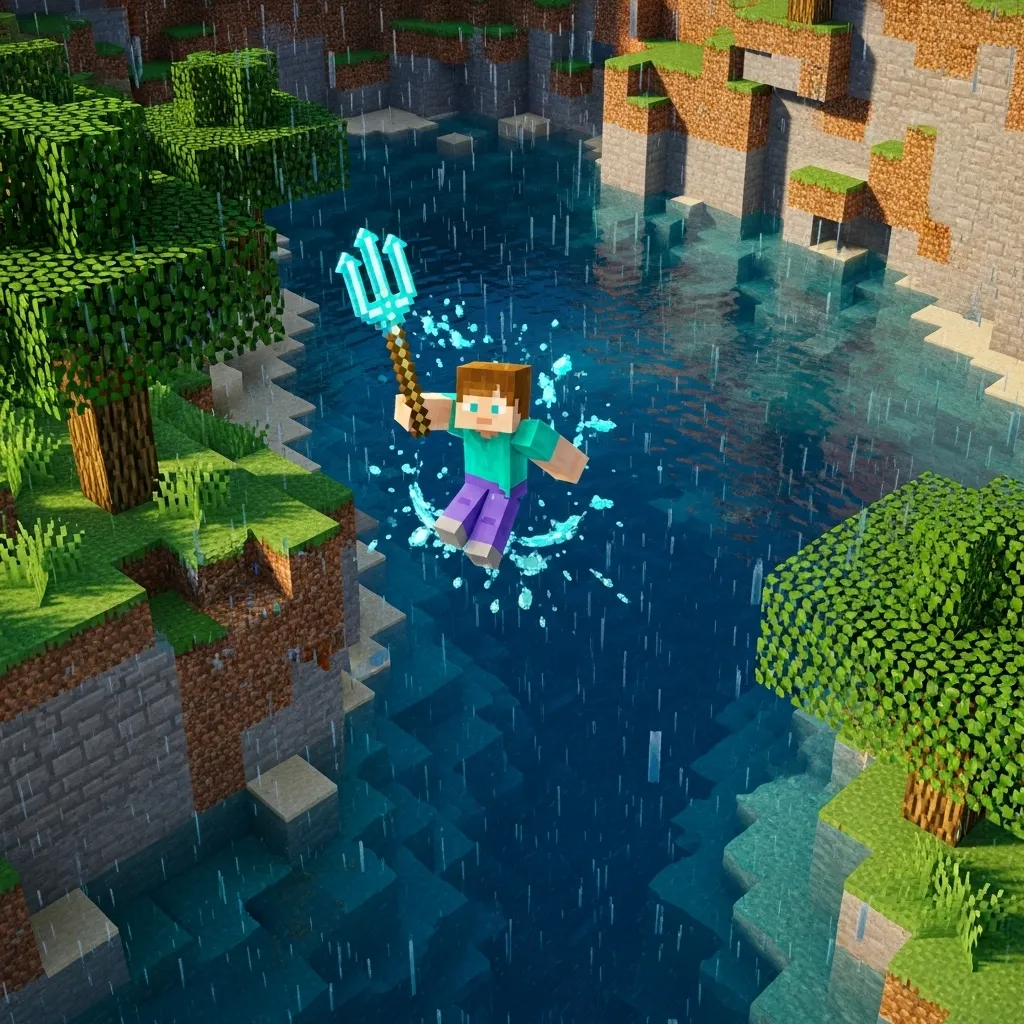
Phase 2: Rainstorm Training (Vertical Resets)
The true offensive and defensive edge of the Riptide comes from its instant vertical launch.
This allows you to nullify fall damage or escape enemy combos.
This requires perfect timing, which is challenging on Bedrock’s sensitive hitboxes.
Drill 2: The Sky Pillar Catch
Wait for a rainy day in your practice world. Build a simple 50-block high pillar.
Jump off the top of the pillar. The critical step is timing your Riptide.
Wait until the last possible second-right before you hit the ground-to Riptide straight up.
The aim is to catch yourself exactly 1 or 2 blocks above the surface to avoid any lethal fall damage.
The risk of failure is high, but that fear sharpens your focus for high-pressure PvP moments.
Phase 3: Advanced Combat Integration
The best players don’t just use Riptide for movement; they use its momentum to set up deadly item swaps.
The instantaneous acceleration is perfect for creating distance or surprise attacks.
Drill 3: The Trident-Pearl Exit
This is your panic button and ultimate evasion tactic. Use Riptide to gain instant height or cover ground rapidly.
While mid-launch, swap to an Ender Pearl and immediately throw it.
Ideally, you throw the pearl in a direction perpendicular to your trident flight path.
This simultaneous displacement makes tracking your movement incredibly difficult for opponents.
Learning this drill requires fast hotkey usage. For more strategic evasion, read our guide on mastering Ender Pearls for PvP escapes.
Here is a summary of the training drills and their key movement goals:
- Water Wiggle: Focuses on lateral aiming control and keeping utility items ready in water.
- Sky Pillar Catch: Focuses on precise vertical timing to reset height and nullify fatal fall damage.
- Trident-Pearl Exit: Focuses on lightning-fast hotbar swapping mid-Riptide for maximum evasion and distance.
Remember that Riptide is one of the fastest movement options in the game when conditions are met.
This chart shows just how much speed advantage you gain by using Riptide III compared to basic movement options:
A bar chart comparing basic movement speeds: Walking (4.3 m/s), Sprinting (5.6 m/s), and Riptide III in rain or water (14.0 m/s).
Once you are hitting 90% success on these three drills, you are ready to dominate advanced Bedrock PvP lobbies.
What other movement tools do you think integrate best with the instant speed provided by Riptide?
Conclusion: Dominating Bedrock PvP Movement
We’ve spent time breaking down the most difficult, high-level movement strategies using the Trident in Bedrock PvP.
You now know how to execute the instant vertical boost and the quick, angled Riptide chains.
However, simply knowing the mechanics is not enough to truly dominate.
True mastery comes from integrating this speed and confusion into your overall combat flow.
The Trident as a Set-Up Tool
Think of your Riptide Trident less as a direct damage tool and more as a momentum creator.
It allows you to instantly reposition, escape danger, or catch a player who thinks they are safe.
If you use a Riptide boost to reset your engagement distance, you must immediately pivot to your next weapon.
This is where combining different high-speed techniques becomes essential.
For example, learning advanced mechanics like the Wind Charge Pearl Catching Technique helps you maintain altitude and momentum after a Riptide boost.
These advanced movement skills are what separate a good player from a top-tier champion.
If you look at how pro players win fights, movement often outweighs raw clicking speed or damage output.
A pie chart showing estimated skill factors: Trident/Elytra Movement (35%), Aim & Melee Combos (30%), Resource Management (20%), and Shield/Block Mastery (15%).
The data suggests that specializing in movement, particularly unique item movement, gives you the biggest competitive edge.
Three Pillars of Riptide Mastery
Keep these three crucial points in mind as you put your trident movement guide into practice.
Control the Environment: You rely entirely on rain or water. Always know where the nearest water source or overhead sky is.
Predict the Foe: Use Riptide to move where your opponent doesn’t expect you to be, not just where they are.
Follow-Through: The Riptide launch is worthless if you land and miss your attack.
When you successfully use a trident dash to gain an advantage, you must execute the immediate counter-attack perfectly.
That perfect follow-up means hitting high-damage critical hits, often requiring you to Master Hit Selecting & S-Tapping for God-Tier Combos right after landing.
Practice these movements until they feel like second nature, even under pressure.
Your goal is to become unpredictable and unbeatable.
Now that you know the secrets of advanced trident movement, what high-stakes PvP scenario are you going to use your Riptide escape in first?
Taking Flight: Making Riptide Second Nature
We’ve covered a lot of ground today, or rather, a lot of air. Riptide isn’t just an enchantment; it’s a complete change in how you view the battlefield.
The biggest hurdle is making the Water Bucket Launch feel natural. It takes dedication, but once you nail that timing, your opponents won’t know what hit them.
Remember that high sensitivity is your friend, especially for those vertical launches that instantly reset your momentum and give you the high ground.
Go practice those diagonal snaps and the auto-fly loop. Stop treating the trident as a novelty and start treating it like the game-winning tool it is.
Now go get wet, aim high, and dominate the skies!
Frequently Asked Questions
How do I activate Riptide when it isn’t raining?
Riptide requires you to be “wet.” The best way to activate it on demand is by using a water bucket.
You must quickly place the water block right before throwing the trident.
The water needs to be in place for the fraction of a second needed to trigger the launch.
Is Riptide III really worth the extra effort compared to Riptide I?
Absolutely, yes! Riptide III gives you a massive speed boost-up to 3.5 times the velocity multiplier of Riptide I under ideal conditions.
This extra speed is crucial for escapes, gaining vertical height rapidly, and executing the advanced burst techniques we discussed.
What is the “Auto-Fly Loop” specific to Bedrock Edition?
The Auto-Fly Loop means that on Bedrock, you can just hold down the throw button (right-click, R2, etc.) while wet.
The game automatically re-throws the trident and restarts the Riptide movement seamlessly. You don’t need precise timing for repeated launches.
Why is high sensitivity important for Riptide PvP?
High sensitivity lets you snap your camera instantly. You need to look straight up, throw the trident, and then look forward again in a fraction of a second.
If your sensitivity is too low, you risk stalling mid-air, allowing your opponent to line up an easy shot on you.