Running out of fireworks mid-fight is a nightmare.
In Elytra PvP, managing your fuel is just as important as hitting your shots.
Let’s master rocket feathering and predictive aiming to dominate the Bedrock skies without wasting resources.
Key Takeaways
- Master the ‘feathering’ technique to save up to 60% of your rocket fuel.
- Use predictive aiming to ‘lead’ your target and overcome Bedrock server latency.
- Follow the 3-Tier Practice System: start with solo flight, then tracking, then combat.
- Maximize your Rocket-to-Distance ratio (RDR) by gliding more and boosting less.
Elytra Rocket Conservation: Bedrock Feathering and Efficiency Metrics
Mastering the Bedrock Feathering Technique
Elytra PvP isn’t just about movement; it’s about managing a limited resource: your fireworks.
If you constantly spam rockets, you will quickly run out of fuel during a long chase or engagement.
The secret to high-level conservation on Bedrock is a technique called “feathering.”
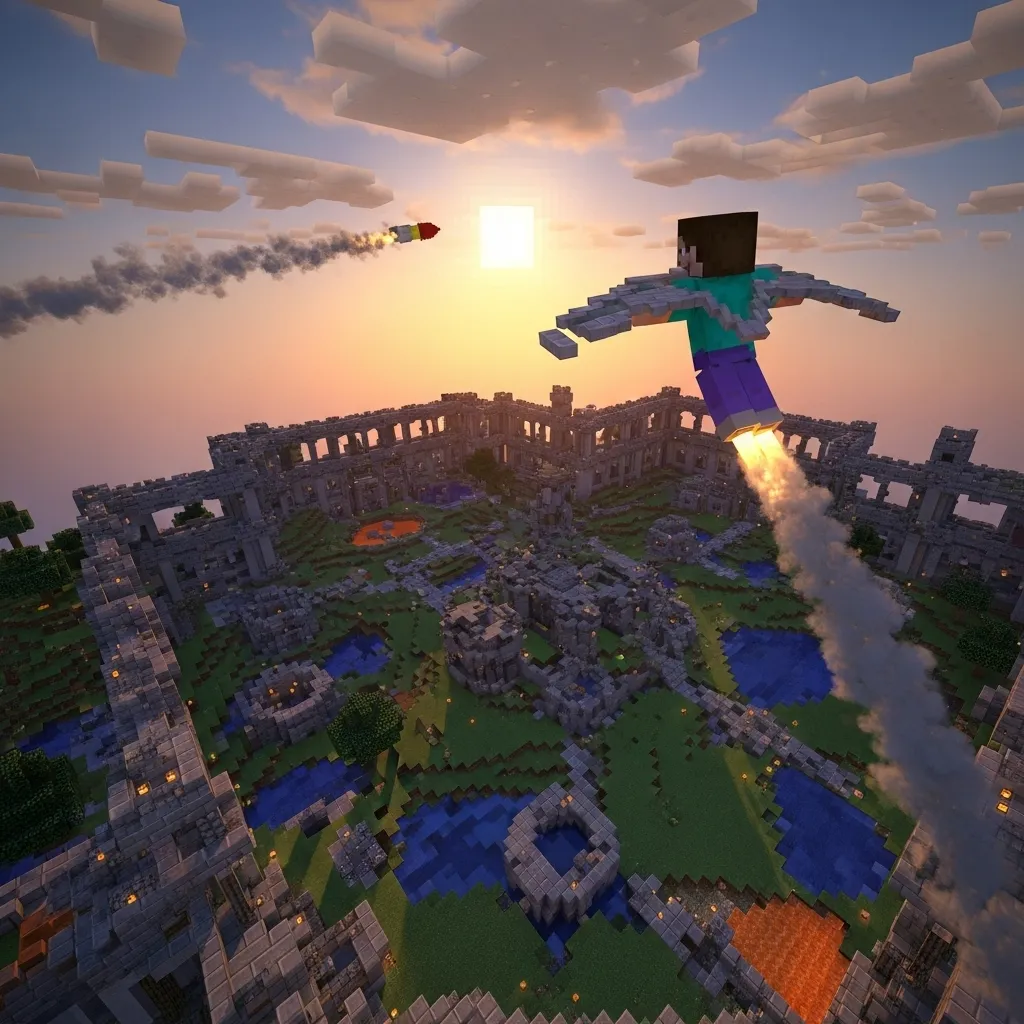
What is Elytra Feathering?
Think of feathering like pumping the gas pedal instead of flooring it.
Instead of holding down the rocket button, you perform quick, precise taps to maintain speed.
A Bedrock rocket gives you a strong vertical and horizontal boost, but you don’t need all of it.
By hitting the button for only a fraction of a second, you use maybe 10-20% of the rocket’s duration.
This provides enough momentum to refresh your glide and delay the drag of gravity without wasting the full explosion.
Rocket Efficiency Metrics in PvP
True conservation means optimizing your Rocket-to-Distance ratio (RDR).
In a typical PvP scenario, the best players minimize their RDR, focusing on maximizing glide time.
The speed boost from a rocket is temporary, but the momentum it grants lasts much longer if managed correctly.
A highly efficient player might use 60-70% fewer rockets per minute than a player who is spam-boosting.
This difference becomes critical when fighting over large distances or in Factions combat.
Understanding when to boost and when to simply glide is a fundamental part of mastering PvP momentum control.
A bar chart comparing estimated rocket consumption per minute: Constant Boost (20), Efficient Feathering (8), Vertical Climbing/Combat (15).
Feathering Tactics for Elytra Combat
When you are in a dogfight, feathering helps you conserve rockets while still performing evasive moves.
Since the Bedrock boost duration is 3 seconds, a quick tap is all you need to change your direction rapidly.
Focus on using rockets only for these three crucial maneuvers:
- Direction Changes: A quick tap while turning violently is more efficient than a sustained boost, especially when initiating a momentum fade maneuver.
- Altitude Recovery: If you drop too low, use a single upward tap to gain necessary height quickly.
- Initial Acceleration: A strong boost at the very start to get maximum speed, then immediately switch to feathering.
Feathering also helps cover sound.
The loud explosion of a firework rocket gives away your position; quieter feather taps are harder for opponents to track.
If you want to know more about the underlying game physics of the item, the technical details about the flight mechanics are listed on the official Minecraft Elytra Wiki page.
How much better could your rocket conservation become if you cut your consumption in half during every PvP match?
Predictive Aiming: Beating Bedrock Latency and Leading Targets
The Latency Problem: Why Direct Aim Fails
When you are zipping around the sky in fast-paced Elytra PvP, timing is everything.
Combat requires accuracy, but trying to hit a moving target with a rocket or an arrow is deceptively difficult.
This difficulty exists mostly because of latency, or “ping,” which is the small delay in data transmission.
Latency is the tiny fraction of a second between when you fire a rocket and when the server registers that launch.
On Bedrock, where speeds are high and pings can be inconsistent, this delay can be a huge obstacle.
If your opponent is flying at peak speed-around 70 blocks per second-they move a significant distance during that delay.
If you aim exactly where they are right now, your rocket will land where they were 100 milliseconds ago.
They will be long gone by then.
Calculating the “Lead” Distance
Predictive aiming means you stop aiming at the enemy’s skin model.
Instead, you aim where the target will be when your rocket arrives.
We call this crucial technique “leading” the target.
Think of it like being an NFL quarterback throwing a football to a receiver.
You don’t throw it at the receiver; you throw it ahead so they can run into the pass.
The core physics behind this is simple: distance equals speed multiplied by time.
You need to estimate the target’s speed and multiply it by your total reaction time plus your ping delay.
Professionals in game design use specific mathematical models to calculate where a projectile should land based on target velocity.
This is key to preventing misses.
While you don’t need to do complex math mid-fight, knowing the principle helps you train your subconscious aim.
Understanding predictive aiming mathematics reinforces the timing necessary for accurate shots.
A line chart showing that as latency (ping) increases, the required prediction lead time (in seconds) also increases linearly, making accurate aiming significantly harder at higher pings.
Reading Flight Patterns and Velocity
How far ahead you need to lead the enemy depends heavily on two key factors: your ping and their current velocity.
If you know you have high ping, you must lead them further.
If your ping is above 100ms, you need to account for a significant lag delay.
In some situations, you can even use this delay to your advantage by anticipating enemy errors.
Learning how to use high ping advantage can help you utilize this knowledge.
The most important step is mastering pattern recognition.
If the player is flying in a straight line, your lead distance is steady and predictable.
This is the easiest target to hit.
If a player is constantly switching between smooth flight and wide angle vs tight strafing, your required lead distance changes instantly.
Practice Drills for Rocket Firing Mastery
You need to train your brain to stop aiming directly at the body.
Aiming at the empty air is the only way to succeed.
Here are a few ways to drill this predictive aiming skill:
- The Phantom Aim Drill: Load onto a PvP server and fly around focusing only on tracking one enemy. Do not fire. Keep your crosshair 3-5 blocks ahead of them at all times. Track the empty space where they are going.
- The Corner Cut Drill: Focus on enemies who are preparing a large turn. Predict the exact moment they will shift momentum and aim for the corner block they are cutting across. Fire the rocket just before they complete the turn.
- Consistent Velocity Firing: Choose an enemy flying straight and fast. Fire three rockets in quick succession, adjusting your aim slightly after each one to see how small deviations impact the hit probability. This helps you lock in your ideal lead distance for that ping level.
Remember, Elytra PvP requires you to be a step ahead of the action, always anticipating the opponent’s next move, not reacting to their last one.
When you are facing a truly unpredictable enemy, which movement pattern do you find hardest to predict, and how do you adjust your lead distance in response?
The 3-Tiered Practice System for Elytra PvP Mastery
Tier 1: The Solo Flight School (Conservation and Control)
Mastery always starts with the basics.
In Elytra PvP, the most fundamental skill isn’t hitting the enemy-it’s staying airborne without running out of gunpowder.
Think of this first tier as learning to drive in an empty parking lot. You need to feel the controls and understand the momentum before adding other cars.
Your goal here is simple: efficiency. Every rocket counts.
Practice launching with minimal height loss and gliding horizontally for the longest possible distance before needing another boost.
You should aim to use no more than 1 rocket every 10-15 seconds.
The goal is to maintain high speed while staying close to a consistent vertical plane, like skimming just over the tops of trees.

Drill 1: The Figure-Eight Loop
- Set up two tall, distinct landmarks (towers, pillars, etc.) about 100 blocks apart.
- Fly an infinite figure-eight pattern between them.
- The challenge is to never hit the landmarks and use the absolute minimum number of rockets to keep your momentum high around the turns.
- This drill trains your tight turning radius and teaches you how much vertical adjustment is needed without wasting fuel.
The Importance of Ping and Input
On Bedrock, your ping plays a massive role in rocket responsiveness. A clean launch requires precise timing.
If you play on mobile or controller, practice minimizing thumbstick/mouse movement while simultaneously tapping the rocket button.
Wasting rockets on choppy launches immediately puts you at a disadvantage in a fight.
Tier 2: The Tracking and Target Acquisition Stage
Once you can fly forever using only a few rockets, it is time to introduce aiming.
This is where you move from just flying to actually tracking a target mid-air, which is much harder than aiming on the ground.
The core challenge is balancing your own flight path (your momentum) with the prediction needed to hit a moving object.
A pie chart showing recommended practice time distribution for complex PvP skills: Conservation & Movement (60%), Aiming & Tracking (30%), and Live Integration & Combos (10%).
Drill 2: Predictive Rocket Firing
This drill requires a friend, or perhaps a flying mob like a Phantom or a Wither, as a moving target.
Fly alongside your target at medium distance (about 15-20 blocks).
The goal is not just to hit the target, but to predict their movement and fire the rocket where they will be, not where they are now.
Since the rocket takes time to travel, learning the projectile speed and drop is crucial for successful Elytra PvP.
You also need to master adjusting your flight path subtly to avoid extreme over-correction while aiming.
Practice both high-speed passing shots and low-speed circling shots to train different aiming angles.
Tier 3: Combat Integration and Dynamic Threats
The final tier puts everything together. This isn’t about isolated skills; it’s about decision-making under pressure.
Can you conserve rockets while maintaining the vertical advantage, all while tracking an opponent who is actively trying to kill you?
This stage focuses on adding combat actions like sword/mace swaps and anticipating complex enemy movement.
The Combat Skill Fusion Table
In Tier 3, you are executing maneuvers that require sequential, perfect timing.
| Maneuver Focus | Core Skill Required | Why It Matters |
|---|---|---|
| Vertical Reset | Precision Rocket Boost | Gaining height advantage and confusing opponent aim. |
| Momentum Control | Feathered Rocket Use | Maximizing glide time after a critical hit. |
| Mid-Flight Combo | Quick Inventory Swap | Executing a devastating combo, like the Elytra Rocket Mace Swap Combo Tutorial. |
A critical advanced technique is knowing when to use short, sharp rocket bursts to dodge incoming rockets or quickly change your trajectory.
This also ties into mastering vertical knockback and spacing techniques to deny your opponent clean hits.
If you find yourself constantly losing fights because you run out of rockets or get sniped mid-air, you need to dedicate more time to the first two tiers.
This three-tiered approach ensures you build a solid foundation before tackling the chaos of live, high-speed combat.
What specific vertical maneuver, like a sudden dive or a rapid ascent, do you find most difficult to execute without wasting a rocket?
Bronze to Silver: Drill Focus for Rocket Efficiency
Breaking the Rocket Spam Habit
When you first start Elytra PvP, it feels like you need to spam rockets to survive.
That immediate burst of speed is addictive, but it drains your resources quickly.
Moving from Bronze to Silver rank is all about treating rockets like gold.
The goal is to move fast using the fewest possible boosts.
If you waste rockets on bad alignment, you will run out of fuel mid-fight.
Mastering the Single Boost (The 45-Degree Rule)
The biggest efficiency jump comes from controlling your angle when you boost.
Most beginners look straight up and boost, achieving massive temporary height.
However, this wastes momentum once you start falling.
Pro players maximize horizontal distance with a slight upward angle.
Aim for a 35 to 45-degree angle above the horizon when you pop a rocket.
This provides enough lift to sustain altitude while focusing most power forward.
This technique is similar to optimizing aerial movements in games like Rocket League.
In high-speed aerial combat, controlling your vertical angle is essential for energy conservation, a concept well-documented in guides for fast-paced titles like Rocket League.
Learning this angle dramatically reduces the number of rockets you need per minute (RPM).
The Importance of Predictive Aiming
Rocket conservation isn’t just about movement; it’s about combat engagement.
When you shoot a player with a bow or crossbow from the air, every missed shot means you have to chase.
Chasing always costs rockets.
To move beyond Bronze, you need to learn predictive aiming.
Instead of aiming at where they are now, aim at where they will be in a second.
This requires observing their strafing patterns and momentum changes.
If you want to improve this skill on the ground first, study how to predict enemy movement in 1v1s.
Think of Bedrock Elytra PvP less like hitting a stationary target and more like leading a clay pigeon.
Conservation Drills for Silver Rank
To cement these efficiency habits, try these simple practice drills.
These exercises help build muscle memory for minimal boosting.
- The Three-Rocket Run: Fly across a large map segment (e.g., 500 blocks) using a maximum of three rockets. Focus on smooth glides between boosts.
- The Mid-Flight Alignment: Boost once, then practice shifting your trajectory by 90 degrees using only subtle pitch and yaw adjustments, without boosting again.
- Altitude Maintenance: Find a set altitude (e.g., Y=150). Try to fly for two minutes without dropping below Y=140, using the minimum number of rockets necessary.
Aiming Tips: Leading Your Target
The time it takes for an arrow to travel means you must compensate for distance.
This compensation is called “leading the target.”
When aiming at a player moving perpendicular to you, you must calculate that lead distance.
If they are 30 blocks away and flying sideways at max speed, aim slightly in front of their flight path.
Experts often describe this as aiming where the enemy will be one second after you shoot.
A bar chart showing estimated lead distance (in blocks ahead of the target) needed for successful hits in Elytra PvP at various ranges.
To consistently hit moving targets, you must factor in two key variables:
| Variable | Bronze Player Focus | Silver Player Focus |
|---|---|---|
| Target Motion | Current location | Predicted trajectory and speed |
| Vertical Aim | Aim for body (often too low) | Aim slightly above the head for drag/drop compensation |
| Rocket Usage | Reactive (after losing height) | Proactive (before speed fully decays) |
This proactive mindset, combined with predictive aim, is what separates a decent flier from an efficient threat, much like how resource planning helps competitive gamers master resource conservation.
What is the single hardest part about consistently hitting a moving target while you are also flying?
Gold Tier Mastery: Aiming Accuracy and Duel Scenarios
Mastering the Predictive Lead Shot
When you reach Gold Tier in Elytra PvP, you stop aiming at the person themselves.
That might sound strange, but think of it like throwing a baseball to a runner. You don’t throw it at the runner’s current position.
Instead, you throw it ahead of them so they run right into it.
In the air, your opponent is moving incredibly fast, and network delay (ping) adds extra difficulty.
You must practice the predictive lead shot. This means anticipating where they will be 0.5 to 1 second from now.
The distance you need to lead your shot depends entirely on their current velocity and how quickly they are changing direction.
A massive part of this skill comes from pure gamesense and learning how to predict enemy movement in 1v1s effectively.
Vertical Aiming and Bedrock Snapping
Most standard PvP focuses heavily on horizontal aiming and strafing. Elytra duels force you to master the vertical axis, too.
A common mistake is forgetting that your target often changes altitude far faster than they change horizontal direction.
If your opponent is dropping steeply to gain speed, you must perform a fast, downward vertical flick with your aim.
Bedrock Edition has a slight aim assist or “snapping” effect, especially noticeable when aiming near players or blocks.
You need to train your muscle memory to ride this snapping motion without letting it pull your crosshair too far away from the target.
Top competitive players spend significant time on vertical tracking drills, according to training philosophy highlighted by ProGuides.
Bringing that same dedication to your vertical adjustments in the air is what pushes you past the average player.
A bar chart showing hypothetical percentage increases in aiming accuracy: General Flight Practice (15%), Horizontal Tracking Drills (25%), and Vertical Target Drills (45%). This illustrates the importance of focused training.
Duel Scenarios: High-Speed Evasion and Counterplay
The Gold Tier master knows how to survive an aggressive dive and turn the fight back around immediately.
Survival is rocket conservation combined with evasive movement that throws off your enemy’s prediction.
If an opponent is closing fast, use tight, small strafes to force them to lead their shot incorrectly.
Quickly dipping down toward the ground or a structure makes their predictive aim much harder to maintain.
The Critical Jousting Pass Maneuver
This maneuver occurs when two players fly directly toward each other. It’s essentially a high-speed game of chicken.
The goal is not usually to hit them on the approach, but to hit them right after they pass you, using your quick turning radius.
This technique requires perfect timing and excellent control over momentum.
By using mastering crosshair placement for max reach, you ensure your rotation is minimal when the enemy passes.
Here is how to execute a successful Jousting Pass counter:
- Identify the incoming target and maintain a neutral flight path (don’t dodge yet).
- Aim slightly to the side of the target’s trajectory (your pre-lead position).
- Just as they pass, use a single, quick rocket burst and immediately pull sharply into the turn.
- Lock onto their back trail instantly; they will often panic and burn rockets defensively.
- Take your shot at the apex of the turn, when your crosshair locks onto their predictable escape path.
Do you prioritize practicing vertical aiming or horizontal strafing when you train for high-speed duels?
Mastering the Skies: Your Journey Continues
This article covered the crucial skills needed to move from a beginner flyer to a true Elytra PvP expert.
It’s not enough to just fly fast; true mastery comes from managing your resources and anticipating the enemy.
Remember the core lessons: feathering rockets saves fuel and keeps you in the fight longer, especially on Bedrock.
Predictive aiming helps you beat frustrating Bedrock latency by always leading your targets.
Don’t forget the practice system! Start with solo conservation, then move to tracking, and finally engage in full combat.
Take these powerful techniques into the server today. The skies are waiting for you to conquer them! Good luck out there.
Frequently Asked Questions
What is “feathering” and why is it important in Bedrock Elytra PvP?
Feathering means tapping the rocket button quickly instead of holding it down.
This technique uses only a small fraction of the rocket’s boost duration.
It’s crucial because it drastically conserves your firework supply, giving you a huge advantage during long engagements.
How does latency (ping) affect my aiming in Elytra combat?
Latency is the delay between your action and the server registering it.
If you aim directly at a fast-moving target, your rocket will land where they were, not where they are now.
This requires you to use predictive aiming, or “leading,” the target to hit them successfully.
What is the Rocket-to-Distance Ratio (RDR)?
RDR is a metric that measures your rocket consumption against the distance you travel.
In simple terms, it tells you how efficient your flying is.
The goal of high-level Elytra conservation is to minimize your RDR by maximizing glide time and using fewer rockets per minute.
What is the easiest way to start practicing rocket conservation?
Start with the Tier 1 Solo Flight School drill.
Try the Figure-Eight Loop drill using tall landmarks about 100 blocks apart.
Focus on maintaining high speed around turns while using the absolute minimum number of rockets possible. Efficiency comes first!